

Updated October, 2026
Losing a parent is hard, and grief does not clear a path for paperwork. Yet here you are with a house that needs decisions made about it, probably sooner than feels right.
Nothing has to be settled this week. Selling a parent’s home after their death begins with legal authority, and most families do not have it yet regardless of how ready they feel. Whether anyone can sell depends on how your parent held title, meaning paperwork filled out years ago or never gotten around to.
This article walks through what has to happen before a sale is possible, what is worth doing while you wait, and what your options look like once the choice is actually yours.
We’re Seller’s Advantage, a family-run brokerage in Southern California that buys homes directly. We have sat with a lot of families in your position, and we have told plenty of them to wait, or to list with an agent instead. Whichever way it goes for you, we are glad to talk it through with no obligation attached.
This is general information, not legal or tax advice. County courts move at different speeds and most estates have something unusual in them, so a California probate attorney is worth what they cost. Start with the deed.
Who Can Sign the Deed
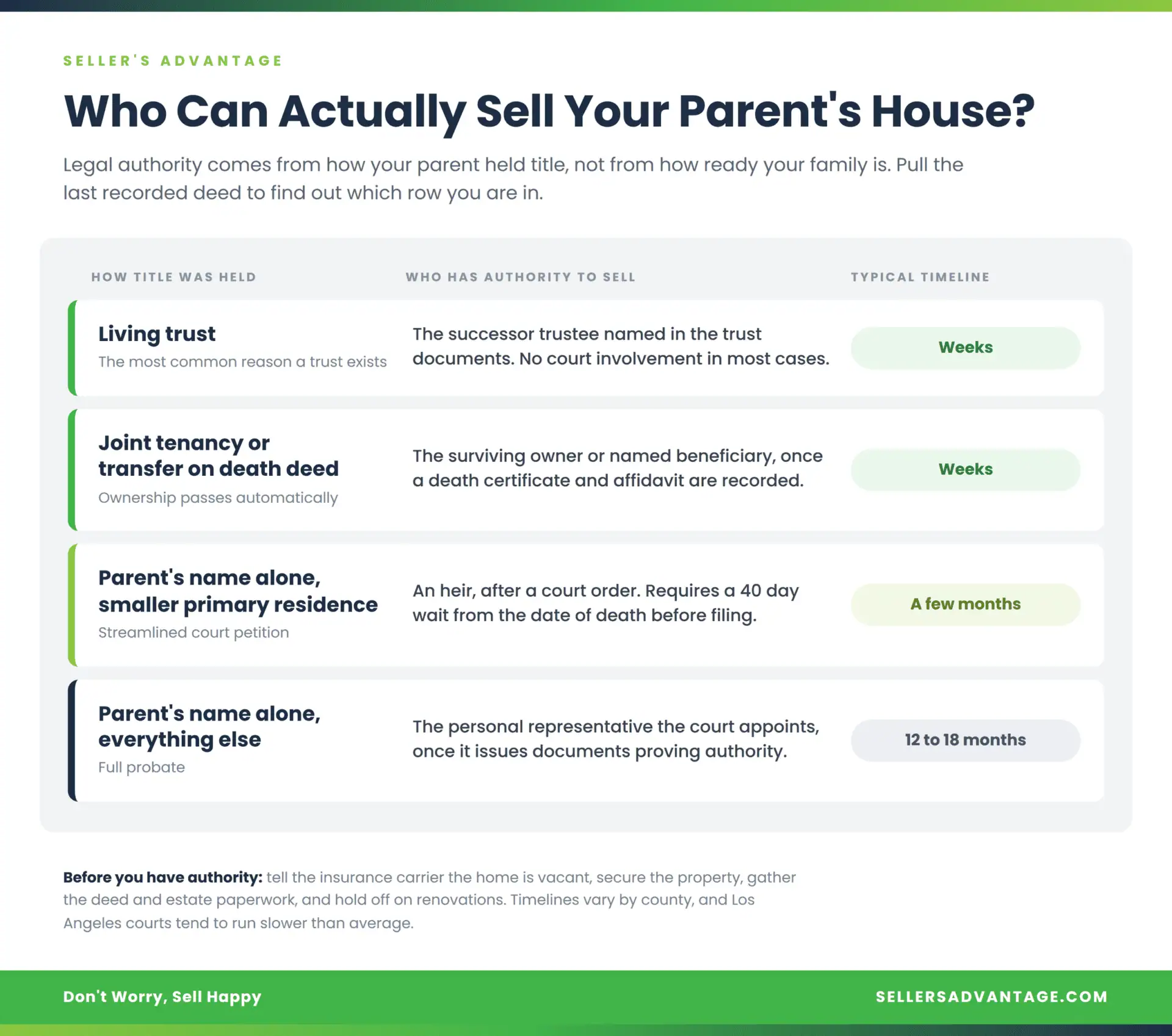
Legal authority to sell comes from how your parent held title, meaning whose name was on the deed and in what form. Four situations cover most families, and they lead to very different places.
If the property was held in a living trust, the successor trustee identified in the trust agreement typically has the power to sell the home without needing to go through court proceedings. This method offers the quickest route to selling and is often the primary reason a trust is established in the first place. That is the fastest path and often the whole reason the trust was set up.
If the house was held in joint tenancy, a form of co-ownership where the surviving owner automatically inherits, or transferred by a transfer on death deed, ownership generally passes outside of court. A death certificate and a recorded affidavit usually handle it.
If the house was in your parent’s name alone, a court has to grant somebody authority before a title company will close a sale. That court process is probate: it confirms who inherits, settles debts, and issues the documents that prove who is allowed to sign.
Pull the last recorded deed before assuming anything. It is a public record at the county recorder’s office and it answers the question in about five minutes. Once you know which category you are in, the next question is who else has a say.
When You Are Not the Only Heir
If more than one of you inherits, all of you own it, and all of you have to sign at closing unless you agree in writing to let one person handle the sale. That includes the sibling who has not returned a call since the service.
Disagreement at this stage is normal and it is usually about grief rather than money. One person needs cash now, another cannot stand the idea of strangers walking through the house they grew up in, and both of those are legitimate positions held by people who are tired and sad. Nobody in this situation is behaving badly by feeling something.
The move that tends to lower the temperature is an independent appraisal, a formal valuation by a licensed appraiser. A neutral number shifts the argument away from what the house is worth and onto what each of you actually wants, which is the conversation you were having anyway. Our inherited-house guide walks through buyouts, mediation, and partition actions in detail.
With the people question at least identified, the next thing worth checking is whether California offers you a way around the court entirely.
The $750,000 Shortcut, and Why It Misses Most LA Homes
There is a real way to skip full probate on a house, and it is newer than most search results reflect.
For deaths on or after April 1, 2025, an heir can file a Petition to Determine Succession to Primary Residence when the home’s gross value is $750,000 or less. The court issues an order transferring the property without opening a full probate case. The rule sits in Probate Code section 13151, and the Judicial Council publishes the current dollar thresholds itself.
Three details decide whether it helps you:
- The $750,000 is gross value, not equity. A house worth $900,000 carrying a $400,000 mortgage does not qualify. The loan is irrelevant to the test.
- It has to have been a primary residence. A rental your parent owned, or a vacation place, falls outside the procedure entirely.
- Forty days have to pass from the date of death before the petition can be filed. Filing early gets it rejected.
One caveat carries real weight in Los Angeles County. Decades of appreciation have pushed typical values across most of the county well above $750,000, which means the shortcut that sounds perfect on paper will not reach a lot of the families reading this. It is genuinely useful in parts of the Inland Empire and for smaller properties. It is not going to help with a bungalow in Culver City. We would rather say that now than have you spend six weeks discovering it.
A separate procedure, the small estate affidavit, covers personal property up to $208,850, and the house is excluded from that calculation, so the two can run alongside each other.
Whichever path applies, there will be a stretch of waiting. That time is more useful than it looks.
What to Do Before You Have Authority
Four things are worth doing while the paperwork works itself out, and one expensive thing is worth not doing.
Call the insurance carrier first. Most homeowner’s policies change coverage once a house sits unoccupied, and a vacancy the insurer never learned about is how families end up with a denied claim after a burst pipe. Tell them the owner died and the house is empty, then ask what the policy requires now.
Secure the property. Change the locks if the house stood open during the service, forward the mail, and keep utilities running at a minimum. Water damage and squatters both begin with an empty house nobody visits.
Collect the paperwork. The death certificate, the will or trust, the last recorded deed, mortgage statements, property tax bills, homeowners association documents if the property sits in an HOA community, and photographs of the current condition. Every professional you speak with over the next year will want some portion of this, and gathering it once spares you repeating the worst month of your life on the phone.
Get a sense of value. A comparative market analysis from a local agent, or a formal appraisal, gives you a real number. Online estimates are a starting point and not much more, particularly on older homes that have not been updated.
Do not renovate. This is where families lose the most money. Tens of thousands go into a kitchen before anyone has confirmed who owns the house, who has to agree to a sale, or whether local buyers even pay for the work. Nothing about the property’s condition needs solving until the authority question is settled.
Once it is settled, the decision opens up.
Your Options Once You Can Sell
Three realistic paths exist. The right one depends on the condition of the house, how far apart everyone lives, how quickly you need to sell, and how much of this any of you has the energy to manage, which is why some families choose a fast cash home buyer in Southern California.
List it with an agent. Usually the top-dollar route, provided the house presents well and somebody nearby can run repairs, staging, and showings. Expect roughly 90 to 120 days on the market plus another 30 to 60 days in escrow, and commissions in the 5 to 6% range, unless you decide to sell the house without a realtor.
Escrow is a neutral third party that holds the money and paperwork until closing. The buyer’s funds land there first, and the existing mortgage, any liens, and overdue property taxes get cleared before the remainder is sent to the estate. A lien is a legal claim against the property, anything from an unpaid contractor’s bill to a judgment over an old debt. You never wire anything yourself.
Keep it or rent it. Worth considering if one of you wants to live there. California’s tenant protection rules and a property tax reassessment both change the math on renting, and that reassessment surprises nearly everyone. Long-held family homes often carry a tax bill set decades ago, and it does not survive most transfers.
Sell as-is to a direct buyer. Selling a house as-is in California means the house transfers in its current condition, with no repairs and no cleanout expected from you. This fits when the house holds forty years of belongings, needs work nobody wants to manage from out of state, or when the heirs are scattered across three time zones. The offer will land below what a fully repaired listing would fetch, because the buyer absorbs the repairs and the risk. What matters is the net, and once you subtract repairs, commissions, and months of property taxes and insurance on an empty house, the gap narrows considerably.
If that last path sounds like your situation, this is how a fast 7-day cash sale works on our end.
If a Direct Sale Turns Out to Be the Fit
We do not put a number on a house we have not seen. Once a member of our team has walked the property, in person or by video if you are out of state, a no-obligation cash offer may come back to you inside of a day. No cleanout first and no repairs.
We don’t charge a commission. Closing can happen as early as 7 to 14 days once the estate has authority to sell, or we can extend the timeline as far out as you need through our California we-buy-houses cash program. Nobody is going to rush you through a house you have not finished going through. If the estate needs funds before the closing date, up to $20,000 of the proceeds can be released early on a cash purchase, to help you start your next chapter. It comes out of what the sale already owes the estate, so it is not a loan and carries no fee.
If listing would put meaningfully more money in your family’s hands, we will tell you that, because our role as a company that buys houses in any condition has to make financial sense for you.
A few things come up in almost every one of these conversations.
Questions Families Ask
Can I sell my deceased parents’ house without probate? Yes, in three situations. The house was held in a living trust, it passed automatically through joint tenancy or a transfer on death deed, or it was a primary residence valued at $750,000 or less and qualifies for the streamlined petition. Outside of those, probate is generally required before anyone can sign.
How long does selling a house after the death of a parent actually take? A trust sale can close within weeks once the successor trustee has the documents in order. A full probate case more often lands somewhere in the 12 to 18 month range, and Los Angeles County tends to move slower than average because of court backlogs.
Do we have to clean the house out first? For a traditional listing, yes, and you will want to. For an as-is sale, no. Take what matters to you and leave the rest where it is, and be aware that selling your home as-is comes with challenges in a traditional listing.
There is still a mortgage on it. Does that stop the sale? No. It gets paid off from the buyer’s funds at closing, before anything is distributed. Recorded liens and unpaid property taxes clear the same way.
Can we sell while probate is still running? Often yes, once the court has granted the personal representative authority to sell. Whether a confirmation hearing is also required depends on the type of authority the court granted.
What if one sibling refuses to sell? Co-owners generally all have to sign. When agreement is genuinely out of reach, California law allows a co-owner to petition the court to force a sale, though the legal fees and the timeline make it a last resort worth avoiding.
None of this has to be solved today.
Talk It Through With Someone Local
You do not have to decide anything today. When you are ready to understand what the house is worth in today’s market and what your family’s real options look like, we are here to help guide you through your options.
Sell Your House Fast For Cash
We Buy Houses in Southern California As-Is
Close on your timeline and avoid the hassle of traditional fees.
Get My Free,
No-Obligation Quote
Call us today at 800-208-3243 and get an offer in as little as 24 hours. It’s quick and easy!
"*" indicates required fields
Southern California’s Most Trusted Home Buyers

