

Updated August, 2026
We Can’t All Be Mr. Fix-It: The California Homeowner’s Guide to Selling As-Is
Look, life happens, and maintaining a home isn’t easy. For many of us, major repairs have taken a back seat to bigger things: raising kids and watching them leave for college, going through a divorce, losing someone we love. Home repairs are expensive, and falling behind on them is nothing to be embarrassed about.
So if you’re looking at a leaking roof, dated plumbing, or just a house full of stuff you don’t want to sort through, here’s the short answer: you can sell your home exactly as it sits, and it’s more common than most people realize.
Selling as-is might be the right solution for you, and you may not be taking the haircut on price you’re expecting. This guide walks you through what “as is” really means in California, what you still need to disclose, and your three main paths: fixing and listing, listing as-is, or selling directly to a local buyer. Keep reading to find out where your home might land.
What “As Is” Actually Means in California Real Estate
There’s often confusion about what “as is” really means. We’re here to offer as much clarity as possible so that you can make an informed choice about selling your home.
Selling your home as-is means you’re saying to buyers: “Here’s the home in its current state. I won’t be fixing anything, offering repair credits, or upgrading before closing.”
That’s the core of an as-is sale. You set clear expectations, and buyers understand they’re accepting the property as it stands.
A few key points to keep in mind:
- Selling as-is doesn’t free you from disclosing known issues. It means no repairs, not no honesty. We’ll cover California’s disclosure rules shortly.
- Buyers can still get a home inspection and may try to negotiate, but you’re free to say no to repair requests.
- “As is” doesn’t always mean the home is falling apart. Sometimes it’s just an older roof, original plumbing, or an HVAC system (that’s the heating and air conditioning equipment) that’s past its prime. Other times, there might be bigger repairs needed. There’s really a wide range.
Why Many California Homeowners Choose to Sell As-Is
There’s no single profile for someone who decides to sell their home as-is. Some homeowners feel overwhelmed by their property’s condition, others have run the numbers and realized that repairing before selling just doesn’t add up financially, and many are simply tired of managing repairs.
Choosing to sell your home as-is is a practical, and often the most convenient, decision for many homeowners. Here are a few common reasons it makes sense:
High Repair Costs in California
Repair costs in Southern California tend to run well above the national average, largely because labor and material costs here are higher across the board. Major systems like roofing, plumbing, and HVAC (the heating and air conditioning system) are often the biggest expenses, and permit fees, drywall repair, and unexpected issues can add to the total once work begins. When more than one system needs attention at the same time, costs can climb quickly.
A full roof replacement, a complete replumbing job, or a new HVAC system are all significant investments, and a licensed contractor can give you an accurate, current estimate based on your home’s size and condition.
Common Situations Where Selling As-Is Fits
Many homeowners find an as-is sale suits their current circumstances. Oftentimes this includes:
- Inherited properties filled with belongings and deferred maintenance
- Long-term rental homes showing wear and tear from tenants
- Older family homes with original plumbing, electrical panels, or roofs dating back to the 1970s and 80s
- Properties with unpermitted work or code violations that would be costly to fix
- Selling a fire-damaged property
Life Changes That Can Create Pressure
Sometimes, the urgency to sell outweighs the desire to renovate. Many homeowners reach this point because of divorce, a job relocation with a tight start date, missed mortgage payments, or health issues that make managing repairs unrealistic. None of that means you’ve failed. It means life happened, and now you need good information so you can make the choice that’s right for you.
Your Legal Responsibilities: California Disclosure Basics
This is the part that tends to trip people up. Selling as-is means no repairs, but it does not mean you can stay silent about what you know about the home. Even in an as-is sale, California law requires sellers to disclose known problems with the property in writing.
Don’t worry, this is more straightforward than it sounds, and we’ll guide you through what it looks like:
- Transfer Disclosure Statement (TDS): California requires sellers of 1 to 4 unit residential properties to complete a transfer disclosure statement under Civil Code §1102. This form asks you to share what you know about the home’s condition: things like roof leaks, plumbing problems, past water damage, foundation cracks, or electrical issues. You fill it out based on your actual knowledge of the property.
- Natural Hazard Disclosure (NHD): Under Civil Code §1103, you must also disclose whether the property sits in a mapped hazard zone for fire, flood, earthquake, and similar natural hazards. This is standard across California.
- What counts as a “known” problem: You’re expected to disclose known material defects, meaning issues that could affect the home’s value, safety, or a buyer’s decision. You’re not required to open up walls or hire every inspector. You disclose what you actually know today from living in or owning the home.
- Exemptions: Sellers who haven’t lived in the home may be exempt from some disclosures, though the duty to share what you know still applies.
We know, this part can sound overwhelming. But disclosures are a normal piece of any home sale, not a hurdle unique to you. If you decide to list with an agent, they’ll walk you through every form and set you up to do it right. And honest disclosure actually works in your favor, because it lowers the chance of disputes after closing.
Most buyers understand that no home is perfect. When the right one comes along, they’ll love your home the way you once did and look past its imperfections. Selling can be an emotional experience, and here’s the silver lining: you’re setting up another family to make memories in it, just like you did.

Your Main Options to Sell a House As-Is (an Honest Comparison)
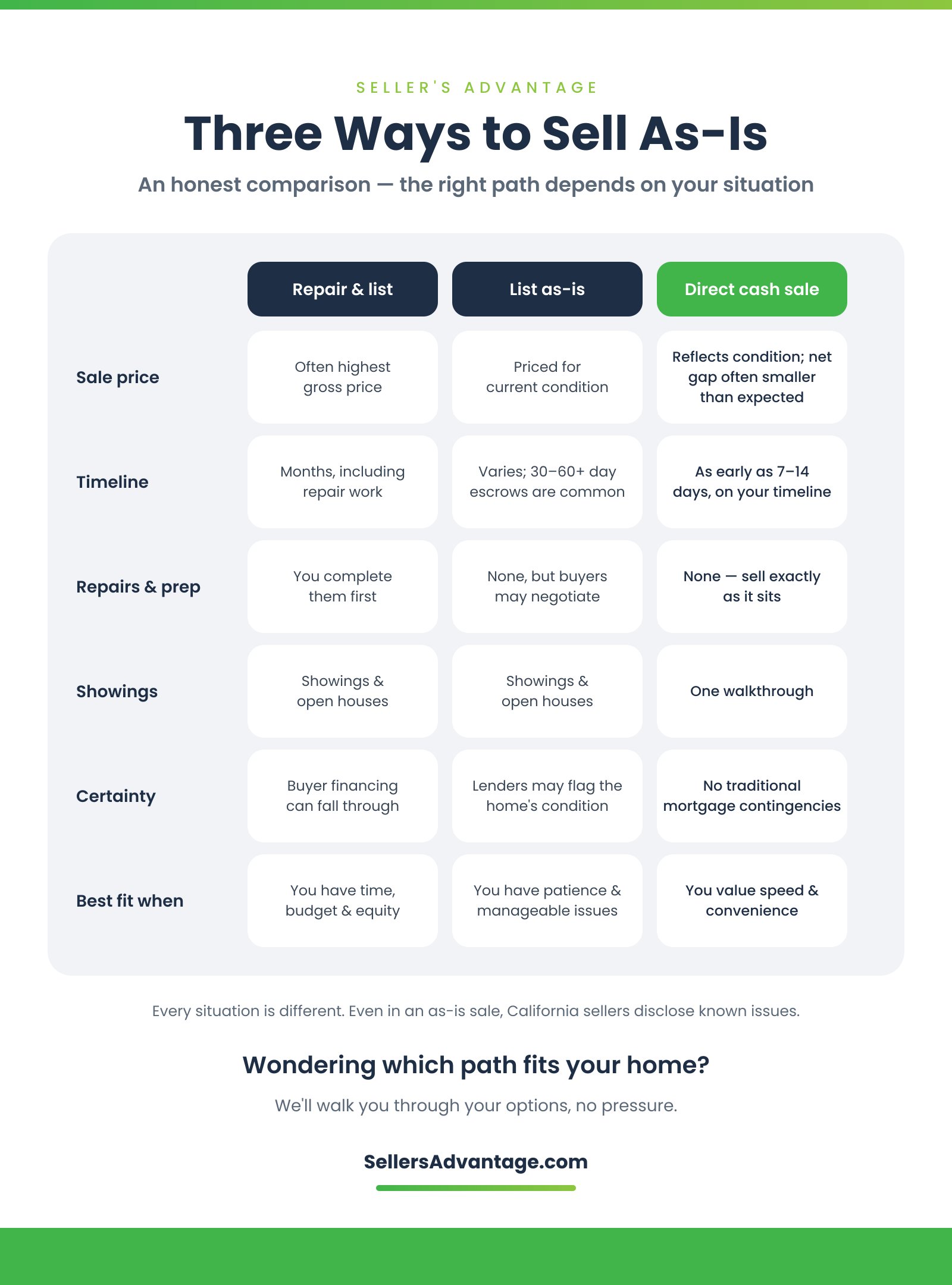
When you decide to sell your house as-is with no repairs, you still have choices about how to do it. There are three main paths:
- Make repairs and list the home traditionally with a real estate agent
- List the home as-is on the open market with an agent, priced for the current condition
- Sell directly to a local cash buyer
Each path involves trade-offs between speed, convenience, net proceeds, and stress. None is universally “best.” The right choice depends on your repair costs, timeline, financial pressure, and what you feel you can manage.
We’re here to talk you through each option, so you can f
eel comfortable making a decision.
Option 1: Make Repairs and List the Home Traditionally
If you have the time, budget, and a home that needs manageable work, making those repairs and listing with an agent can often bring you the highest sale price.
It helps to first understand which repairs are major and which are minor, so you can make a plan.
- Major repairs might include roof replacement, foundation work, upgrading the electrical panel, replacing the HVAC system, or replumbing the entire house.
- Minor repairs could be fresh paint, updated light fixtures, simple landscaping, or new hardware.
Knowing the scope of work will give you a clearer picture of the effort and cost involved, helping you decide if this path fits your situation.
The challenge is that most buyers using financing (FHA, VA, or conventional loans) face minimum property standards set by their lender. If the home has active roof leaks, unsafe wiring, extensive mold, or non-working major systems, the lender may refuse to approve the mortgage. That means the sale can fall apart after you’ve already invested weeks or months.
Other considerations with this path:
- Permits in California cities can add weeks and hundreds (sometimes thousands) of dollars to repair timelines
- You’ll likely deal with contractor delays, especially during busy seasons
- Living through renovations (or managing them) is stressful
- You’ll carry ongoing costs (mortgage payments, property taxes, insurance, utilities) the entire time, which can add up quickly
This route may make sense if you don’t have an urgent timeline and you have enough savings or equity (the portion of the home’s value you own outright, beyond what you owe) to comfortably fund the work.
Option 2: List the Home As-Is on the Open Market
You can list your home as-is on the MLS (the Multiple Listing Service, the shared database agents use to market homes to the widest pool of buyers) with a real estate agent. This approach lets you put your property out there without the hassle of repairs, while still highlighting the things that make your home special, like its location, lot size, neighborhood vibe, or views.
When you list as-is, you’ll probably see phrases like “as-is sale,” “seller won’t make repairs,” or “priced to reflect current condition” in your listing. These set clear expectations and help attract the right buyers.
Now, here’s the thing: the pool of buyers for as-is homes tends to be smaller than for move-in-ready properties. That means fewer folks to bid it up, which can limit negotiation power. Your buyers will often include:
- Real estate investors looking for a project
- Buyers eager to take on a fixer-upper in a great neighborhood at a lower price
- Some traditional buyers using renovation loans, like FHA 203k
- iBuyers (large companies that make automated online offers), though they usually steer clear of homes needing major repairs
It’s also important to keep in mind that even with an as-is listing, buyers usually get a home inspection. They may ask for price reductions or credits based on what’s found, and some might walk away if the issues feel too big. As-is homes often sell for meaningfully less than fully updated ones, depending on the repairs needed.
While this path can sometimes bring you a higher sale price than selling directly for cash, it often means longer wait times, more back-and-forth about repairs, and the risk that financing falls through when lenders flag problems.
If you have the time and patience, and your home’s condition isn’t too daunting, listing as-is can be a smart way to attract buyers who see the potential and are ready to take it on.
Option 3: Sell As-Is Directly to a Local Buyer
A cash buyer is someone who purchases a home without needing traditional mortgage financing. That means no contingencies that you would find in a traditional mortgage loan (a contingency is a condition, like loan approval, that must be met before a sale can close). Without those conditions in the way, the sale tends to move faster and with fewer surprises, and cash buyers typically purchase homes in their current condition, regardless of repairs needed.
In Southern California, selling a property as-is to a direct buyer can be a practical option for homeowners seeking a straightforward, convenient sale without the usual hassles.
What a direct cash sale offers for as-is homes:
- A faster timeline: closing can happen as early as 7 to 14 days, or extend further out if you need more time
- Skip repairs, showings, open houses, and staging entirely
- Leave behind items you don’t want or aren’t ready to move
- Choose a closing date that fits your schedule
Cash offers are generally lower than what a fully repaired home might bring in a traditional sale. Offers typically reflect the home’s current condition and the cost of the repairs and time involved. But here’s what surprises most sellers: once you factor in repair expenses, agent commissions, and ongoing carrying costs (the mortgage, taxes, insurance, and utilities you keep paying while a home sits on the market), the net difference between a cash sale and a traditional sale is often much smaller than expected. If this path sounds right for you, the key is finding a trustworthy, reputable company to guide you through it.
How Seller’s Advantage Helps Southern California Homeowners
Seller’s Advantage is a local, family-owned real estate solutions company and licensed brokerage. Some companies put the home under contract and assign it to an investor who wants to make updates or renovations. Seller’s Advantage works differently: we buy homes directly, and a cash purchase is just one of the paths we offer.
Because every homeowner’s situation is different, we have more than one way to help. We can buy your home in any condition, list it for you if the open market is the better fit, and in some cases, provide up to a $20,000 cash advance to help you start your next chapter. Whichever path fits, our team will walk you through the entire process.
Here’s how it works:
- A no-pressure conversation. You tell us about your situation and the home. We listen, ask a few questions, and figure out which path might be the best fit for you.
- A single walkthrough. We schedule a time that works for you to see the property in person. You don’t need to clean, stage, or complete any repairs first. We regularly see properties with boxes stacked in the garage, furniture from decades past, and systems well past their prime. We mean it kindly when we say we’ve seen it all.
- You may receive a cash offer within 24 hours of us seeing the home. The offer comes with clear terms, and we don’t charge a commission. If the offer doesn’t work for you, there’s no fee for asking and no obligation to accept.
- You pick the closing date. If you choose to move forward, closing can happen as early as 7 to 14 days, or we can extend the timeline to accommodate your needs. We won’t rush you out of your home. For your safety, funds are handled by a non-interested third party: the buyer wires the funds to an escrow company (a neutral company that holds the money until the sale is complete).

FAQs About Selling a House As-Is With No Repairs
“How fast do cash buyers actually pay the home seller?”
The escrow process will determine how fast a cash buyer actually pays you. In a cash sale, this process is much quicker than a traditional home sale, as we have the flexibility to close on your desired timeline. Similar to a traditional sale, funds are distributed after the close of escrow in a cash home sale, with no unique delays.
“Will I get in trouble if I sell as-is and something breaks later?”
Full, honest disclosure of known material defects is your key protection. If you told the buyer about every issue you were aware of, normal wear or problems that develop after closing are generally the buyer’s responsibility. Where sellers run into trouble is withholding information about problems they knew existed. A real estate attorney can help you make sure your disclosures are thorough.
“Can I sell an as-is home that doesn’t meet minimum property standards for loans?”
Yes, but your buyer pool will be limited. Financed buyers may not be able to get loan approval, which is exactly why as-is properties tend to attract cash buyers and some buyers with renovation loans. The property’s condition determines who can realistically make an offer.
“Do I need a pre-listing inspection if I’m selling as-is?”
It’s optional. A pre-listing inspection can help with pricing and give you a clearer picture of what to disclose, but it’s another cost, and anything the inspector finds becomes something you’d need to disclose. Many as-is sellers choose to skip a formal inspection and simply disclose what they already know from owning the home.
“Can I sell as-is if I’m behind on payments or facing foreclosure?”
In some situations, yes. A sale completed before a foreclosure is finalized may help resolve the loan, depending on your equity, your timeline, and how far along the process is. If you’re in this spot, please know you’re not alone, and you have more options than it may feel like right now.
It also helps to know the law gives you more room than most people assume. Under federal rules, your servicer generally can’t begin the foreclosure process until you’re more than 120 days behind on payments, which buys you time to weigh your options. California’s Homeowner Bill of Rights adds another protection called a ban on “dual tracking,” meaning that once you’ve submitted a complete application for help like a loan modification, the lender can’t push forward with a foreclosure sale at the same time. And even if a sale date has been set, California law generally lets you reinstate the loan, meaning catch up on what you owe to stop the process, up until five business days before the scheduled trustee sale.
None of this is legal advice, and timelines can vary, so it’s worth confirming the specifics for your situation. Talk to your lender, and consider speaking with a HUD-approved housing counselor or a real estate attorney to understand every path available. We’re also happy to walk through your situation with you, with no pressure and no obligation.
“What does a ‘no obligation cash offer’ really mean with Seller’s Advantage?”
It means exactly what it sounds like. You can request an offer, review it, ask questions, and choose not to accept, with no fee and no pressure to say yes. An instant online offer isn’t how we work; we take the time to see the home and understand your situation before presenting a fair cash offer. If it doesn’t work for you, no hard feelings.
“What types of buyers actually look for as-is properties?”
As-is homes typically attract several types of buyers: real estate investors planning to renovate, buy-and-hold investors looking for long-term rentals in good locations, and some traditional buyers comfortable with a fixer-upper, especially when inventory is tight. Each of these buyers evaluates the home differently, which is why getting multiple perspectives can be helpful.
“Can I sell a fire-damaged property?”
Yes! Our team provides a number of solutions for that exact situation. Contact us today or learn all about how to sell a fire-damaged property.
Explore Your Options With Seller’s Advantage
We’re here to help you find the best path for your situation. Whether that means a direct cash sale, listing the home, or simply understanding your options better, our goal is to support you in making the choice that feels right. Whatever you’re navigating, we’ll guide you through it.
If you’re a Southern California homeowner curious about what your home could sell for exactly as it sits today, please reach out. Our team will explain how we calculate offers and help you compare all the possibilities.
Sell Your House Fast For Cash
We Buy Houses in Southern California As-Is
Close on your timeline and avoid the hassle of traditional fees.
Get My Free,
No-Obligation Quote
Call us today at 800-208-3243 and get an offer in as little as 24 hours. It’s quick and easy!
"*" indicates required fields
Southern California’s Most Trusted Home Buyers

