
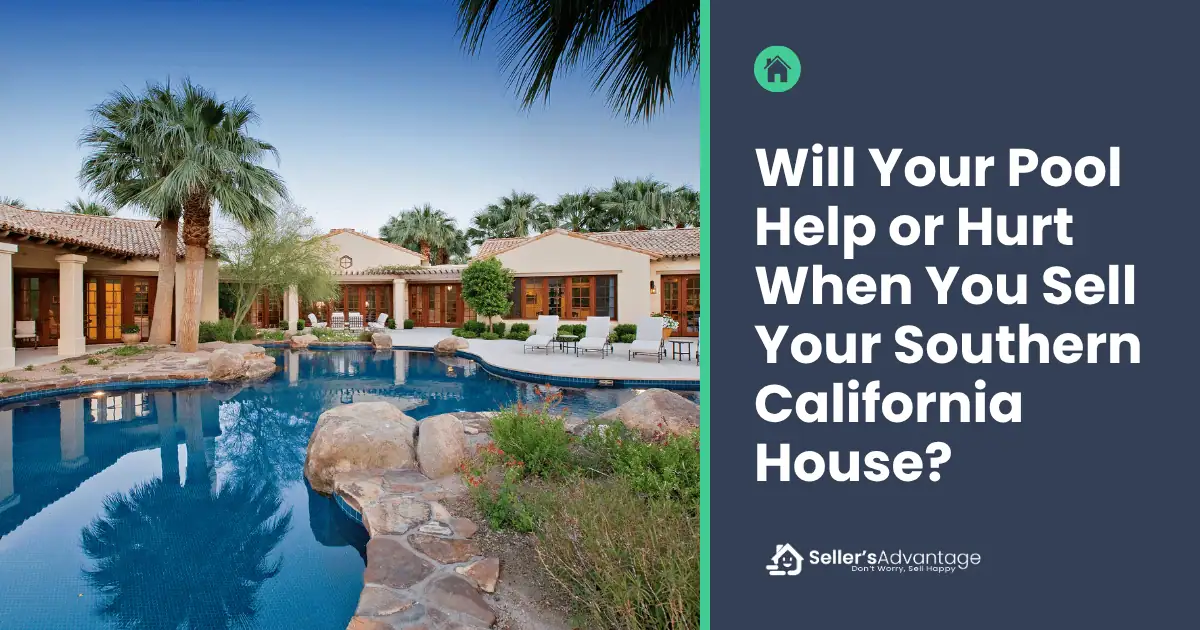
Maybe the swimming pool was the reason you bought the house. It hosted birthday parties and a few kids learning to swim. These days it might feel more like a chore. The pump hums louder every year, and the water turns green after one busy week.
If you’re thinking about selling a house with a pool in California, you’re probably asking one big question. Will the pool help the sale, or scare potential buyers off? Keeping a pool in shape takes real time and money.
We’re Seller’s Advantage, a family-run home buyer based in Southern California. We’ve bought many local houses with pools in every kind of shape. Location makes a difference. Long, hot summers in the Inland Empire and the Coachella Valley make staying cool a real need, so a pool home with a working pool draws many buyers there. In cooler areas near the coast, more buyers see a pool as one more thing to maintain.
We’re also a licensed California brokerage, so we can help you list the house or buy it directly. If listing would put more money in your pocket, we’ll tell you so. Either way, we’ll guide you through it one step at a time.

Why Buyers Split on Pools
Sellers often feel stuck because they hear opposite advice. One person says a pool adds property value, and another says it drags a sale down. Both can be true. For some buyers, a pool is a selling point, and in a luxury neighborhood or gated community it can feel like a must-have feature. Budget-conscious buyers tend to see three things instead: maintenance costs, insurance, and safety.
Families with small children often have the biggest safety concerns, and for good reason. According to the CDC, drowning causes more deaths among children ages 1 to 4 than any other cause.
The pool’s condition shifts the math too. A well-maintained pool with newer equipment looks like a feature. A neglected pool with old equipment looks like a project, and buyers tend to guess high when they price a project in their heads.
California regulates pool safety closely, so that’s worth understanding next.
The Safety Rules Your Buyer Will See
Many homeowners worry they’ll have to rebuild the backyard before they can sell. Under state law, that generally isn’t the case.
California’s Pool Safety Act lists seven drowning prevention safety features:
- A fence or wall that separates the pool from the house
- Removable mesh fencing with a self-closing, self-latching gate
- A safety pool cover, manual or powered
- Alarms on house doors and windows with direct access to the pool
- Self-closing, self-latching devices on pool doors, mounted high so kids can’t reach them
- An alarm that sounds when someone enters the water
- Another protection that’s tested and certified to work as well as these
A 2017 update to the law, known as SB 442, raised the bar. A new or remodeled pool at a private single-family home now needs at least two of these features before the city signs off on the permit. A permit is the city’s written approval for construction work.
State law doesn’t make you add features to an existing pool just because you’re selling. Some cities and counties have their own rules, so check with your local building department.
What the law does change is the inspection. A home inspection is a visual check of the house that a buyer usually orders before closing. When real property with a pool or spa is sold, California requires the inspector to note which of the seven features it has. If it has fewer than two, the report has to say so plainly.
Some buyers also pay for a professional pool inspection, where a pool specialist checks the surface, plumbing, and equipment.
One exception applies to spas and hot tubs. A spa with a locking safety cover that meets the state’s standard falls outside the two-feature requirement.
Those inspection reports are one way a buyer learns about your pool. The other is what you share yourself.

What You’ll Share With a Buyer
Disclosure can feel uncomfortable when the pool isn’t in great shape. Most sellers aren’t trying to hide anything. They just aren’t sure what counts.
Most California home sales use a form called the Transfer Disclosure Statement, or TDS. It’s a checklist of what you know about the house. The form asks whether the property has a pool, a spa, a hot tub, or a pool or spa heater. It also asks about a child-resistant barrier, meaning a fence or similar barrier that keeps kids out of the pool area.
The same form asks whether you know of significant defects. Pool problems are normal things to list, like a leak, cracked plaster, or a heater that quit years ago. The TDS also asks about work done without permits. If the pool or its equipment went in without one, that goes on the form too.
Some sales follow different rules. Certain probate and trust sales are exempt from the TDS form. A real estate attorney can tell you which disclosure rules apply to your sale.
While you sort out the paperwork, the pool keeps costing money every month.
The Costs That Keep Running Until You Close
A pool doesn’t take a break while the house is on the market. You’ll keep paying for chemicals, power for the pump, and maybe a pool service. Skip a few summer weeks and the water can turn green fast, which is a real hassle if you’ve moved out.
Insurance adds another layer. Liability coverage is the part of a homeowners policy that pays if someone gets hurt on your property. The insurance industry treats a pool as an attractive nuisance. That means it can draw people in, including kids who weren’t invited, which raises the risk for pool owners.
The National Association of Insurance Commissioners, a group of state insurance regulators, points out in its guide for consumers that some insurers ask for a fence or locked gate. Some won’t cover a home with a pool at all. An umbrella policy, which is extra liability coverage on top of a homeowners policy, is a common add-on.
If coverage has become a struggle, we’ve covered your choices in our guide on what to do when you’re priced out of home insurance.
None of this means you made a mistake by owning a pool. It just means weighing your options.
Five Ways to Handle the Pool
There’s no wrong choice here, only the one whose benefits fit your house and budget.
1. Fix it up and show it off. A pool inspection can show what needs work first. Clear the water, trim the landscaping around the pool area, and stage the backyard so buyers can picture relaxing there. A clean pool looks better when you post listing photos.
2. Add safety features. A removable mesh fence or a safety cover can help put buyers with young kids at ease. Check your city’s permit rules before you start.
3. Sell it as-is and adjust the price. Selling as-is means selling the house in its current condition, without making repairs. Some sellers list this way and offer a credit instead. A credit is money taken off what the buyer owes at closing, so the buyer can handle repairs. Our guides to selling a home as-is go deeper.
4. Remove or fill in the pool. Orange County, for example, requires a demolition permit. A filled-in area also can’t support a room addition until a soil engineer checks the ground. Plan to tell buyers the pool was filled in, too.
5. Sell as-is to a cash buyer. Most buyers borrow money from a bank to buy a home. A cash buyer pays with their own funds instead, and you skip the prep work entirely.
For most sellers, the bigger question is how to sell. The two main routes look quite different with a pool in the picture.
Listing It vs. Selling It As-Is
A traditional sale means listing the house on the open market with a real estate agent. With a pool in good shape, this route often brings the highest price. It also takes time. A listed Southern California home often spends 90 to 120 days on the market, then another 30 to 60 days to close.
After the inspection, many buyers ask for repairs or a credit. Agents also usually charge a commission, which is a fee based on a percentage of the sale price.
Selling as-is to a cash buyer works differently, and it can help you sell faster. The buyer takes on the pool’s repairs and risk, so the offer usually comes in below a top-dollar listing. What matters most is your net proceeds, meaning the money you keep after costs. Once you subtract repairs, commission, and months of pool care, utilities, and insurance, many sellers find the gap is smaller than they expected.
A cash sale also has no contingencies like the ones in a traditional mortgage loan. A contingency is a condition, such as loan approval, that must be met before closing.
If the as-is route sounds closer to what you need, it helps to see what happens to the pool when you sell that way.
What We Do With Your Pool
Buying houses in any condition is a big part of our business. When we buy a house with a pool, we don’t ask you to fix it, drain it, or put up a fence first. Someone from our team walks the property with you, in person. We look at the pool surface, the equipment, and any safety features, and we factor repairs into our number.
Once that walkthrough is done, we may be able to put a no-obligation cash offer in front of you within 24 hours. There’s no pressure to say yes, and if listing fits better, we’ll talk through that too.
Should you say yes, the closing date is yours to choose. We can close as early as 7 to 14 days. Need longer to pack or find your next place? We’ll set a later date that works for you, with no pushing.
Escrow is an independent company that keeps the buyer’s money and the signed documents safe until the sale is final. We wire our purchase funds to the escrow company. Escrow then pays off your mortgage and any liens, which are legal claims against the property for unpaid debts. Whatever is left goes to you, and you never have to wire money to anyone.
We don’t charge a commission. We also pay the escrow company’s fees and the title insurance, which protects against hidden ownership problems. Recording and transfer fees, the government charges for filing the sale with the county, are on us too. Your mortgage payoff, recorded liens, and unpaid property taxes come out of your proceeds at closing.
Some sellers need money before closing day to help them start their next chapter. When we’re buying for cash, up to $20,000 of what you’ll receive at closing can come to you sooner. That money is already yours, so it isn’t a loan, and no fee gets added on top.
Our team will explain each step as it happens. Sellers usually have a few more questions by now.
Questions Sellers Ask About Pools
My pool is green. Is that a deal-breaker?
Not usually, though buyers may wonder what’s wrong underneath. A pool service can often clear it up before photos go online. If you’re selling as-is to a cash buyer, you can leave it exactly as it is.
Can I still sell if the pool went in without permits?
Yes. List it on your disclosure form. A traditional buyer may ask questions or request a credit, while a cash buyer usually accounts for it in the offer. If you aren’t sure how to describe it, a real estate attorney can help.
If your question isn’t on this list, we’re glad to answer it directly.
Talk It Over Before You Decide
Deciding what to do with a pool you’ve cared for over the years isn’t always an easy call. At Seller’s Advantage, we understand that it’s a big decision, and you don’t have to figure it all out today. Whether you choose to fix it up, list it on the market, or sell it as-is, we’re here to walk you through every step with honest advice and a friendly hand. Let’s talk about what makes the most sense for you and your home.
Talk with our team about your house and pool →
Sell Your House Fast For Cash
We Buy Houses in Southern California As-Is
Close on your timeline and avoid the hassle of traditional fees.

Get My Free,
No-Obligation Quote
Call us today at 800-208-3243 and get an offer in as little as 24 hours. It’s quick and easy!
"*" indicates required fields
Southern California’s Most Trusted Home Buyers

