

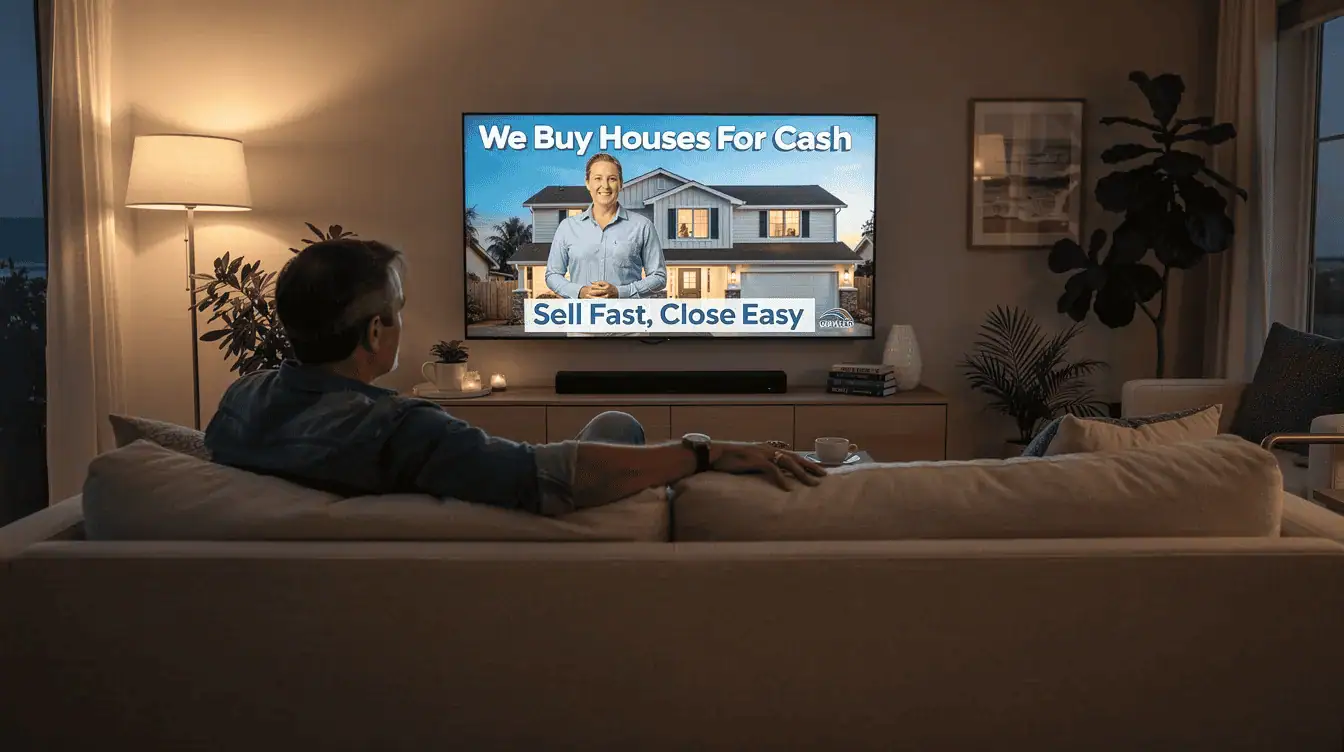
You saw the TV commercial between the weather and the late news. A company says it buys houses in any condition, closes quickly, and skips the repairs. TV commercials for house buyers run in the same breaks as car dealers and injury lawyers. So a fair question shows up: is a home buyer that advertises on TV a real company, or the kind of pitch you should ignore?
Asking that question is the right instinct, and plenty of Southern California homeowners ask it before they ever pick up the phone. A house is usually the largest thing a family owns. Nobody should hand it over to a name they heard in a 30-second spot.
We’re Seller’s Advantage, a family-owned, licensed California brokerage that buys homes directly across Southern California, and yes, we run TV commercials. This article explains why cash home buyers like us pay for airtime and what a 30-second spot can’t tell you. It also shows how to check any real estate company before you call the number on the screen. If listing with an agent turns out to be the better move for you, we’ll say that when we talk.
Why the Ad Reached You
Most people who end up selling a house for cash weren’t shopping for a cash buyer a month earlier. Something changed. A parent passed away and left a house in another county. A roof problem turned into a repair bill nobody budgeted for. A job moved. A marriage ended. An insurance company sent a non-renewal notice on an older home. Those situations don’t come with a search history. Nobody types “cash home buyer” into Google until they already know it’s an option.
Television reaches people before they know what to search for. That is the whole reason a home buyer pays for airtime. A commercial plants one simple idea: a house can be sold without fixing it first. The idea waits until it’s needed. Some homeowners who call us mention seeing the ads long before their own situation made them relevant.
Southern California is also one of the largest TV markets in the country. One spot on a Los Angeles station can reach families in Long Beach, Riverside, and the Antelope Valley at the same time. A company that buys houses across several counties can’t knock on every door, so it hires an ad agency, buys the airtime, and lets the market come to it. The ad’s only real job is to connect a homeowner with a phone number.
There is one more reason, and it’s the one that matters most to you. Airtime costs real money, and every dollar is paid before the ad runs. A station won’t run a spot for a company that can’t cover it. Most advertisers also watch their own results through ad-analytics dashboards that log each airing, station, and time slot, which means they expect the ads to keep running. A buyer that spends on television is usually planning to be around next year. That doesn’t prove a company is good. It does mean the company is real, has a budget, and can be found again.
What 30 Seconds Can’t Tell You
An ad can tell you a company exists and what it does. It can’t explain whether that company is right for your house, and in the world of home buying ads, that gap is where most bad experiences start. There isn’t room to explain how an offer gets calculated, or how a title search checks for old claims against the property. There’s no room for what happens if your home has a tenant, an open permit, or a lien (a legal claim against the home, like unpaid taxes).
The ad also can’t give you a number. Any buyer that names a price for your home before anyone has seen it is guessing, and a guess is not an offer. Real offers come after a walkthrough. For us, that means someone from our team stands in the house first. They look at the roof, the plumbing, and the foundation, and they ask about your timeline. Only then is a figure written down.
So treat a commercial the way you’d treat a friend mentioning a contractor: a name worth looking into, not a decision already made. Federal law requires every TV ad to be truthful and not misleading. The Federal Trade Commission enforces that standard for television the same way it does for print and online ads. Truthful is a floor, not a recommendation. A true ad can still come from a company that’s a poor fit for your situation.
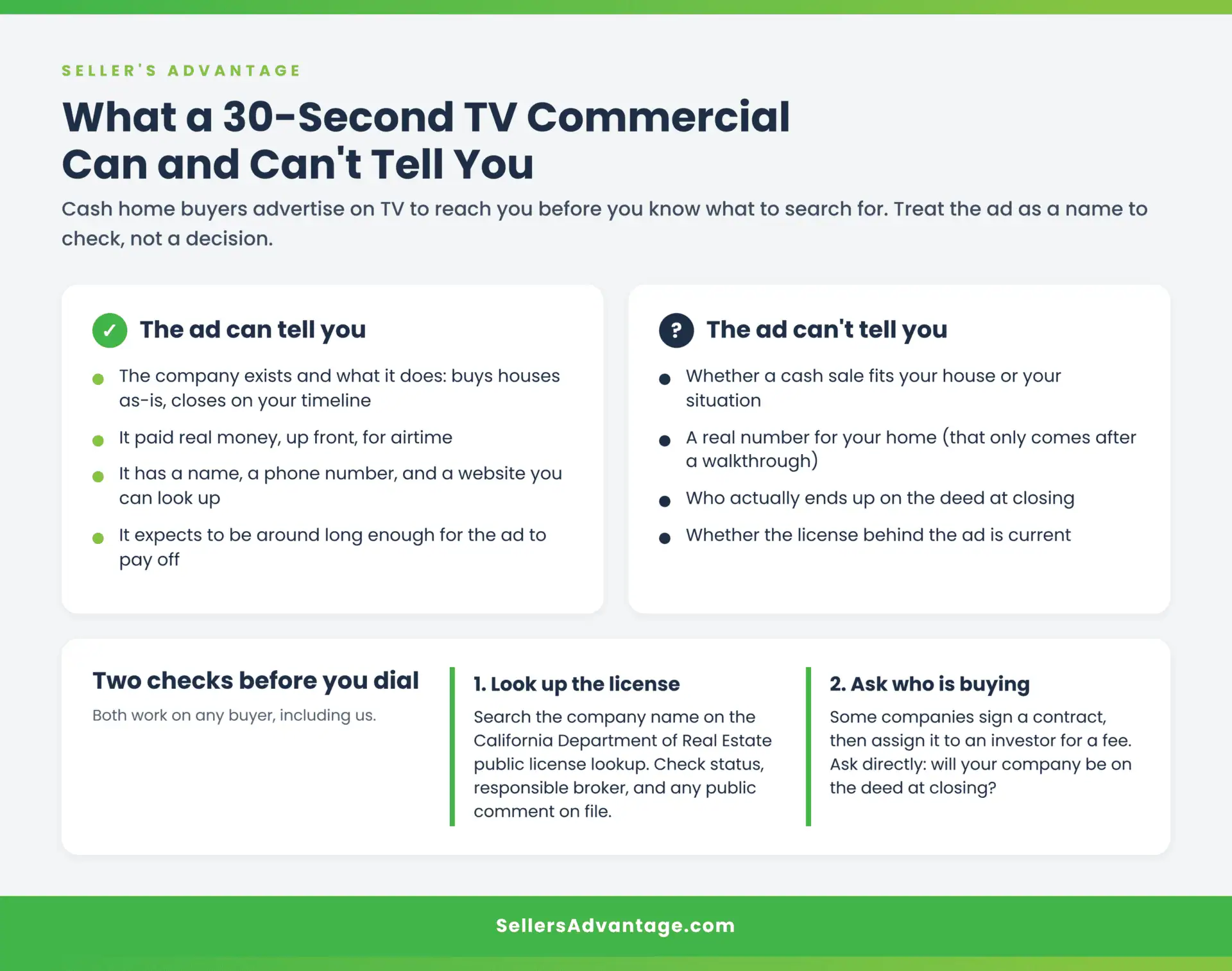
Two checks tell you most of what the ad left out, and both work on any buyer, including us.
Two Checks Before You Dial
Look up the license. Companies that buy and sell homes for other people need a California real estate license, and many direct buyers hold one as well. If a commercial calls a company a licensed brokerage, that claim is easy to test. The state’s Department of Real Estate (DRE) runs a free public license lookup. Enter the company name and you’ll see whether the license is current, who the responsible broker is, and whether any public comment is on file. It takes a minute and tells you more than any ad will.
Ask who is actually buying the house. Some companies never intend to own your home. They put it under contract, then assign that contract to an investor who wants to renovate it. They collect a fee in between. That approach is legal, and our guide to how cash home buyers work describes it in more detail. The trouble starts when it isn’t disclosed. Your sale then depends on a stranger the company still has to find. Ask directly: will your company be on the deed, the document that records who owns the home, at closing?
Reviews, pressure tactics, and proof of funds (a bank statement or bank letter showing the buyer actually has the money) matter too. That longer checklist lives in our guide to common cash buyer scams, along with an overview of the benefits of selling your house to cash investors. Read it before you sign anything with anyone.
Once a company passes those checks, the real question is whether a cash sale fits your situation at all, especially if you’re weighing options for selling a California house that needs work.
When Cash Fits and When It Doesn’t
An honest buyer will tell you a traditional listing is sometimes the better path, because it is. If your home is in good shape and you have time for showings and repair requests, listing with an agent will usually bring the highest sale price. Expect the home to be listed on the market for about 90 to 120 days, followed by an additional 30 to 60 days in escrow. Escrow is the closing phase managed by an independent third party who holds the funds and documents until the sale is finalized. This period often presents challenges for sellers opting to sell their homes “as-is,” as detailed in our guide to selling your home as-is. Plan for a commission and some repairs along the way.
A cash sale trades some of that price for certainty and speed. The buyer takes on the repairs and the risk, so the offer sits below what a fixed-up home might list for. What matters is the net. That’s the money that actually reaches you after commissions, repairs, and months of mortgage payments come off the top, along with the taxes, insurance, and utilities you pay while you wait. Many sellers find that gap is smaller than it looks on paper, especially on older Southern California homes where repair bids run high.
Cash tends to make sense when the home needs more work than you want to fund, or when you need to sell on a set date rather than wait for the market and want a fast, as-is home sale for cash. It fits when co-owners live in different states and can’t coordinate a listing, or when a tenant is in place. It also fits when a move or an insurance non-renewal leaves you without the months a listing needs. Our guide to selling an inherited house in California walks through the full set of options, including keeping the home or renting it, if you want the longer version.
If a direct sale is the fit, what follows is what a call to the number on our ad actually starts, and our overview of how the cash sale process works fills in each step in more detail.
What a Call To Us Actually Starts
The first call is a conversation. Nobody reads you a script. Someone on our team asks about the house, the timeline, and what’s driving the sale. You can ask anything you want back. If it sounds like listing would serve you better, we’ll say so on that call.
If you’d like to go further, you can request a walkthrough at the property. That can be in person, or over video when you live far away. Nothing needs to be cleaned or repaired first when you work with a buyer that purchases California homes for cash in any condition. Once someone from our team has seen the home, you may have a no-obligation cash offer in hand within 24 hours, and in some cases you can sell your house in as little as 7 days. That offer reflects the home’s condition, its location, and what’s happening in the local market right now.
You choose whether to accept. If you agree to the offer, we provide the paperwork, you sign, and you pick the closing date. Closing can be as early as 7 to 14 days. If you need longer, we stretch the timeline to fit your move. We won’t rush you out of your home. We don’t charge a commission. We also cover the escrow fees, title insurance, transfer fees, and recording fees, the closing costs that go to the escrow company, the title insurer, and the county.
Escrow is where the money moves, so it helps to know the order. We wire our purchase funds to the escrow company. Escrow then pays off your mortgage and any liens, and whatever remains is sent to you, giving you the same certainty and speed described in our cash for houses program in Los Angeles. Nothing is ever wired from your side.
One option some sellers ask about: on cash purchases, if you need money before the closing date, we can advance up to $20,000 of what you’re owed. It’s deducted from your proceeds at closing, so it’s your own money arriving sooner. There’s no loan and no added fee, and the point is to help you start your next chapter, just like our broader service to buy houses for fast cash in California.
That’s the whole process. A few questions still come up on almost every first call, so they’re answered below, and our overview of cash for houses in Los Angeles expands on what that looks like in the local market.
Questions We Get Often
Are the people in the commercials actors? The team members you see are real employees. You can put names to faces on our team page and watch the ads themselves on our commercials page, or browse our we buy houses blog posts and articles to see how the service works in different real-world situations.
Does calling obligate me to anything? No. Plenty of homeowners call to ask questions, get a number, and decide to list instead, or explore selling a house that’s already listed on the market. That’s a fine outcome.
Why is a cash offer lower than the estimate I see online? An online estimate assumes a finished home sold to a traditional buyer over several months. A cash offer prices in the repairs, the risk, and the speed. Compare what you’d actually keep from each path. If you want a second opinion on value, ask an agent for a comparable market analysis, which measures your home against recent nearby sales, or order a formal appraisal.
Can I check your license the same way? Please do. Search our company name on the DRE lookup linked above. The license number is also in the footer of every page on this site.
What if my house has a tenant or is in probate? We’ve bought homes with tenants in place, and we’ve worked alongside many probate attorneys on inherited sales. We don’t handle probate ourselves. California tenant law adds steps of its own. Both situations take a bit more conversation up front, and our collection of sell my house fast articles for California homeowners covers many of the edge cases.
If those answers raised new questions, that’s what the first call is for, and our FAQ on selling a house without a realtor can help you think through more of the details before you dial.
Ready To Talk It Through?
Seeing an ad and wanting to check it out is exactly the right first step. At Seller’s Advantage, we encourage you to run the license lookup, read through honest reviews, and reach out with any questions you have. There’s absolutely no pressure from our side, and it costs nothing to explore your options. Whether that turns out to be a cash sale, a traditional listing, or even holding onto your home while you weigh your choices, we’re here to support you every step of the way with understanding and care.
Talk with our team about your situation →
Sell Your House Fast For Cash
We Buy Houses in Southern California As-Is
Close on your timeline and avoid the hassle of traditional fees.
Get My Free,
No-Obligation Quote
Call us today at 800-208-3243 and get an offer in as little as 24 hours. It’s quick and easy!
"*" indicates required fields
Southern California’s Most Trusted Home Buyers

