

You’ve probably noticed that everyone giving you advice on selling your home also wants your business. The real estate agent says list it. The cash home buyer says sell it to us. Both can point to a reason, and neither one is going to volunteer the case for the other side. So you’re left sorting it out on your own, usually while life is already asking a lot of you.
We’re Seller’s Advantage, a family-owned Southern California company that buys homes directly. We’re also a licensed California brokerage, which means we can list a home the traditional way when that’s the better fit. We’ve bought homes all over the region for years. A fair number of the homeowners who called us listed instead, because a traditional sale was going to put more money in their pocket. When that’s true for you, we’ll say so.
Southern California prices are high, which cuts both ways. A few percent in commission is real money, and so is a few percent left on the table by selling too fast. Sometimes the traditional route wins outright. Knowing when starts with being clear on what each selling process actually involves.

Two Very Different Ways to Sell
A traditional listing means hiring a real estate agent to market your home to the public. Your agent puts the home on the MLS, the Multiple Listing Service, which is the shared database other agents use to find homes for their buyers. Potential buyers tour the home and make offers, and most buyers borrow the money from a bank. That’s called buyer financing, and the deal depends on their mortgage approval coming through. Your agent earns a commission, a percentage of the final sale price, paid at closing. Some sellers use a discount broker, an agent who charges lower listing fees in exchange for fewer services, while others want a full-service agent who handles everything.
A cash buyer is a company or individual, and most are investors, who purchases the home directly, without listing it, and without the contingencies you’d find in a traditional mortgage loan. Most cash buyers purchase as-is, meaning in the home’s current condition, with no repairs required from you. Cash buyers offer speed and fewer contingencies. Because they take on the costly repairs and the resale risk, a cash offer is typically a lower price. A financed buyer might pay more once the home has been fixed up and marketed.
Neither path is right for every property sale. So which one is the right path for yours? A handful of signs make the answer fairly clear.
Five Signs You Should List It
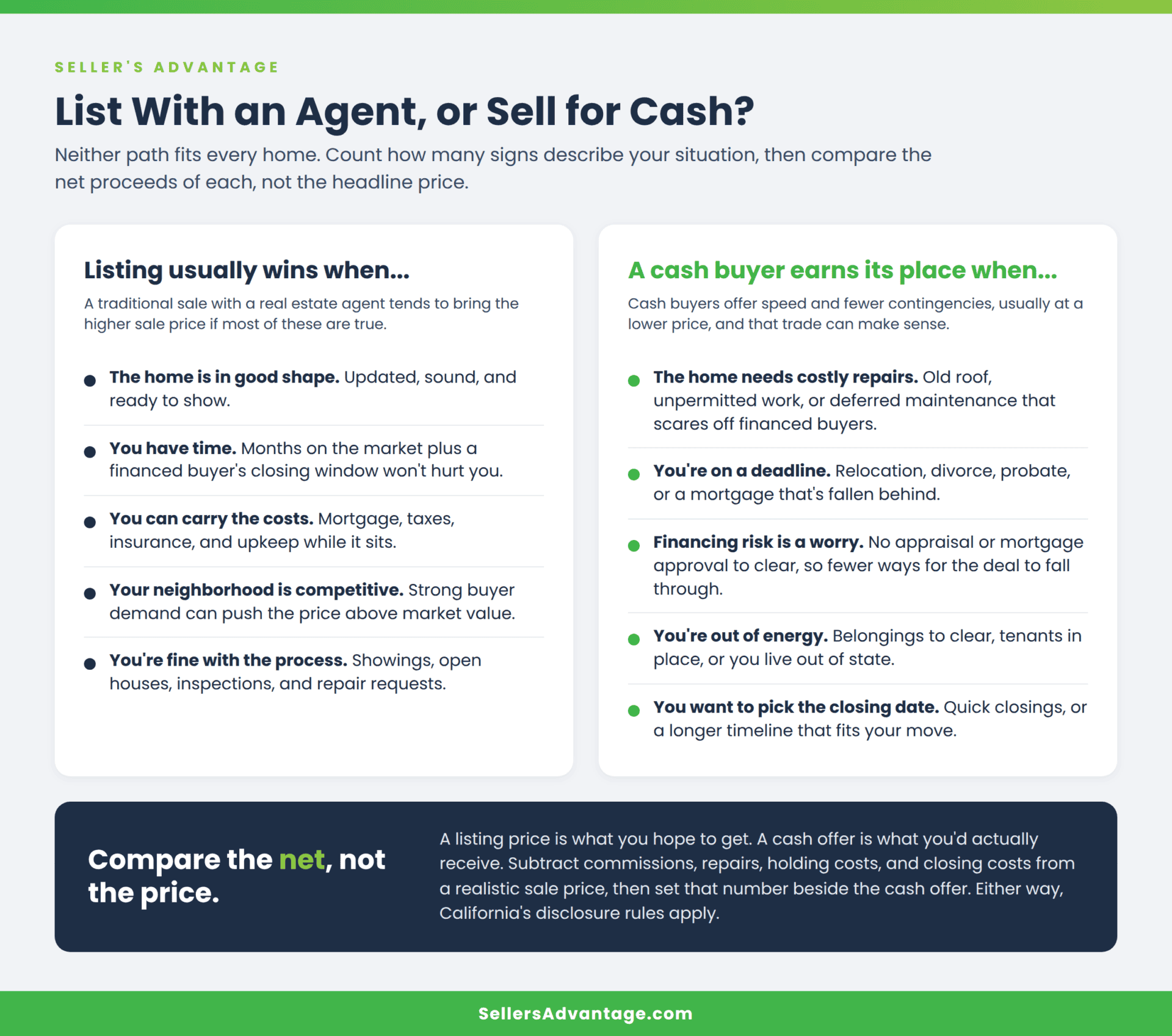
Certain situations tip the scale clearly toward an experienced agent. If most of these describe you, listing deserves a serious look.
Your home is in good shape. A traditional buyer is paying for a home they can move into and enjoy. Updated kitchens, a solid roof, working systems, and a clean yard all push the sale price up. If your home already shows well, you’re leaving money behind by selling it as a fixer-upper. A higher sale price is the whole point of listing, and this is where it comes from.
You have timeYou have time to wait. In Southern California, a traditional home sale typically takes about 90 to 120 days to find a buyer, plus an additional 30 to 60 days to complete the closing process. This timeline is necessary because buyers who require financing need that period for their mortgage to be approved and finalized. Financed buyers tend to need that closing window for their loan to fund. That timeline is fine if you’re not under pressure to move. It’s a problem if you are.
You can afford the carrying costs. While the home sits on the market, you’re still paying the mortgage, property taxes, insurance, utilities, and upkeep. Those are called holding costs. If you can cover them comfortably for several months, a slower sale doesn’t hurt you.
Your neighborhood is competitive. In parts of Orange County, the Westside of Los Angeles, coastal San Diego, and the nicer pockets of the Inland Empire, buyer demand is strong. A well-priced listing there can draw more than one competitive offer. That competition is exactly what pushes a price above market value, higher than any single buyer would pay on their own. An agent with real market knowledge of your local market knows where that demand is and how to price for it.
You’re comfortable with the process. Showings, open houses, buyer inspections, and repair requests are all part of a traditional sale. So is the occasional deal falling apart at the last minute when a buyer’s financing doesn’t come through. Some homeowners handle that fine. Others would rather not have strangers walking through the house every weekend.
If four or five of these fit, a good agent is very likely your better option, and maximizing profit is a reasonable goal. If only one or two do, keep reading, because the picture changes.
When a Cash Buyer Earns Its Place
Some homes and some situations simply don’t fit the traditional process well.
A home with major deferred maintenance, an old roof, or unpermitted work will scare off buyers who need traditional financing. The bank’s appraiser may flag the problems. An appraisal is the bank’s own valuation of the home, and if it comes in low or notes serious defects, the financed offer can collapse. Cash sales skip that step entirely, which is why quick closings are realistic in a way they rarely are with a traditional sale.
Time pressure is the other big one. A job relocation, a divorce settlement, a probate deadline, or a mortgage that’s fallen behind can all make a five-month listing feel impossible. A direct sale can close in weeks rather than months, on a closing date you choose. For many homeowners in that spot, it’s the more convenient option even at a lower price.
There’s also the simple matter of energy. If the home is full of belongings or you live out of state, coordinating repairs and showings can be more than you have in you right now. That’s a real cost, even if it never shows up on a closing statement.
Our guide to how cash home buyers work goes deeper on how those buyers price a home, the potential drawbacks, and how to spot a bad one. For this article, the point is narrower. Whether a cash sale makes sense depends on your personal situation and your financial goals, and the next section is how you find out.
Compare the Net, Not the Price
The biggest mistake homeowners make in any real estate transaction is comparing a cash offer to a listing price. Those aren’t the same kind of number. A listing price is what you hope to get. A cash offer is what you’d actually receive. The fair comparison is net proceeds, meaning what lands in your bank account after everything is paid.
Both paths run through escrow, so it’s worth defining once. Escrow is a third party that holds the money and paperwork while the sale is finalized, and the person managing it is sometimes called the closing agent. The buyer’s funds go to the escrow company, escrow pays off your mortgage and any liens from those funds, and what remains is sent to you. A lien is a debt legally attached to the property, like unpaid taxes or a contractor’s claim. At no point are you the one wiring money to anyone.
For a traditional sale, start with a realistic sale price based on the current market, not the top of the range. Then subtract:
- Your agent’s commission, plus any buyer agent commissions you agree to cover. Commissions aren’t set by law and are fully negotiable. Since 2024, whether you offer anything to the buyer’s agent is your call, and your agent can’t advertise that offer on the MLS. Many sellers still offer something to attract buyers. The National Association of Realtors explains the current rules.
- Repairs and updates needed to make the home show well, plus anything the buyer asks you to pay for after their inspection.
- Holding costs for the months the home sits on the market and in escrow.
- Your share of closing costs. These include escrow fees, title fees for the insurance that protects the buyer’s ownership, and transfer taxes charged by the county or city when a property changes hands.
For a cash sale, take the offer and subtract your existing mortgage balance, any liens, and unpaid property taxes, sometimes called back taxes. With a direct buyer that covers closing costs and charges no commission, that’s usually the whole list.
Put the two net numbers side by side. Many homeowners find the gap is smaller than they expected. Some find it’s large enough that listing is obviously more money and worth the wait. Either way, you’re making an informed decision with real numbers instead of a guess. And one part of the process stays the same no matter which number wins.
What You Still Have to Disclose Either Way
One thing surprises a lot of sellers: California’s disclosure rules don’t change based on who buys the home.
State law requires sellers of one-to-four-unit residential property to complete a Transfer Disclosure Statement, a form that tells the buyer what you know about the home’s condition. That obligation applies to an as-is sale just the same as a traditional one, and the law says it can’t be waived. You can read the statute’s own language at California Civil Code Section 1102.1.
Selling as-is means you won’t be asked to fix anything. It doesn’t mean you get to stay quiet about a leaking roof. Any buyer worth working with, agent or direct, will expect you to fill out the form honestly.
That’s worth knowing before you talk to anyone, because it shapes the questions you should ask.
Questions to Ask an Agent Before You Sign
If you’re leaning toward listing, the listing agreement is a contract, and it deserves the same care as any other. A few questions worth asking up front:
- What comparable homes have sold nearby in the last 90 days, and at what price? An agent’s pricing should rest on recent comps, meaning similar homes that recently sold, not on what a neighbor is asking.
- What’s your commission, and what are you recommending I offer the buyer’s agent?
- How long is the listing agreement, and what happens if I want to cancel early?
- What repairs or updates do you think are worth doing, and which ones aren’t?
- What’s your plan if the home hasn’t sold in 60 days?
A good agent will answer all of these without getting defensive. If the answers are vague, that’s useful information too.
The same standard applies to a direct buyer, who should be able to explain their offer, the costs they pay, and how closing works before you sign anything.
A few more questions come up in almost every one of these conversations.
Common Questions
Can I list the home and still get a cash offer? Yes. Getting a no-obligation cash offer before you list gives you a floor to compare against. If the listing brings in more, take it. If it doesn’t, you already know your fallback.
Do cash buyers always offer less than market value? Usually, yes, because the investor takes on repairs, holding costs, and the risk of the resale, and needs to make a profit on the other side. The question that matters is whether the difference in net proceeds is worth the time, repairs, and uncertainty you’d avoid.
What if I’m behind on my mortgage? Timing matters more in that situation, and the right move depends on how far behind you are and what your lender has told you. Our article on being behind on your mortgage walks through every option, including the protections California gives you.
Is a cash sale safer? A cash sale has fewer ways to fall apart, because the funds are already there, with no mortgage contingency and no bank appraisal to clear. A traditional sale carries more contingencies, meaning conditions the buyer can use to back out, but it also has the upside of competing offers.
What about companies that make instant offers online? Some large companies, sometimes called iBuyers, make offers from a computer estimate and charge a service fee. Same rule applies. Compare the net, not the headline number.
Where Seller’s Advantage Fits
If listing sounds right, we’re glad we could help you get there. A licensed brokerage like ours can handle the listing if you want one company for the whole conversation.
If a direct sale sounds closer to what you need, our process is built to be simple. Once one of our team members has walked through the home, in person or on video, a no-obligation cash offer may follow within a day. We don’t charge a commission, and we pay the escrow fees, title insurance, recording fees, and transfer fees, so those costs don’t come out of your side. You choose the closing date. It can be as early as 7 to 14 days out, or we can stretch the timeline to fit your needs. We won’t rush you out of your home.
One more option some sellers find useful: when we buy the home for cash, we can advance up to $20,000 of your money before closing to help you start your next chapter. That amount comes out of what you’d receive at closing, so it isn’t a loan and there’s no fee attached.
Whichever way you go, we’ll walk you through it. And if we think an agent would get you a better result, we’ll be the first to say it.
Talk with our team about your situation →
Sell Your House Fast For Cash
We Buy Houses in Southern California As-Is
Close on your timeline and avoid the hassle of traditional fees.
Get My Free,
No-Obligation Quote
Call us today at 800-208-3243 and get an offer in as little as 24 hours. It’s quick and easy!
"*" indicates required fields
Southern California’s Most Trusted Home Buyers

