
The county tax bill tends to arrive right when life is busiest. If you’re also thinking about selling, or you’re already in the middle of a sale, a two-part bill with two different deadlines can raise a dozen questions at once.
That confusion is normal. Most California homeowners only deal with the tax calendar once or twice a year, and a sale changes who owes what. Missing a date doesn’t mean you were careless. It usually means the paperwork from a move, a loss, or a busy season got stacked on top of it.
We’re Seller’s Advantage. We’re a family-owned company that buys homes directly across Southern California, and we’re also a licensed California brokerage. Tax payments come up in nearly every sale we’re part of. We’ll walk you through how the calendar works and how it plays out when a house changes hands.
Your 2026-27 Property Tax Deadlines
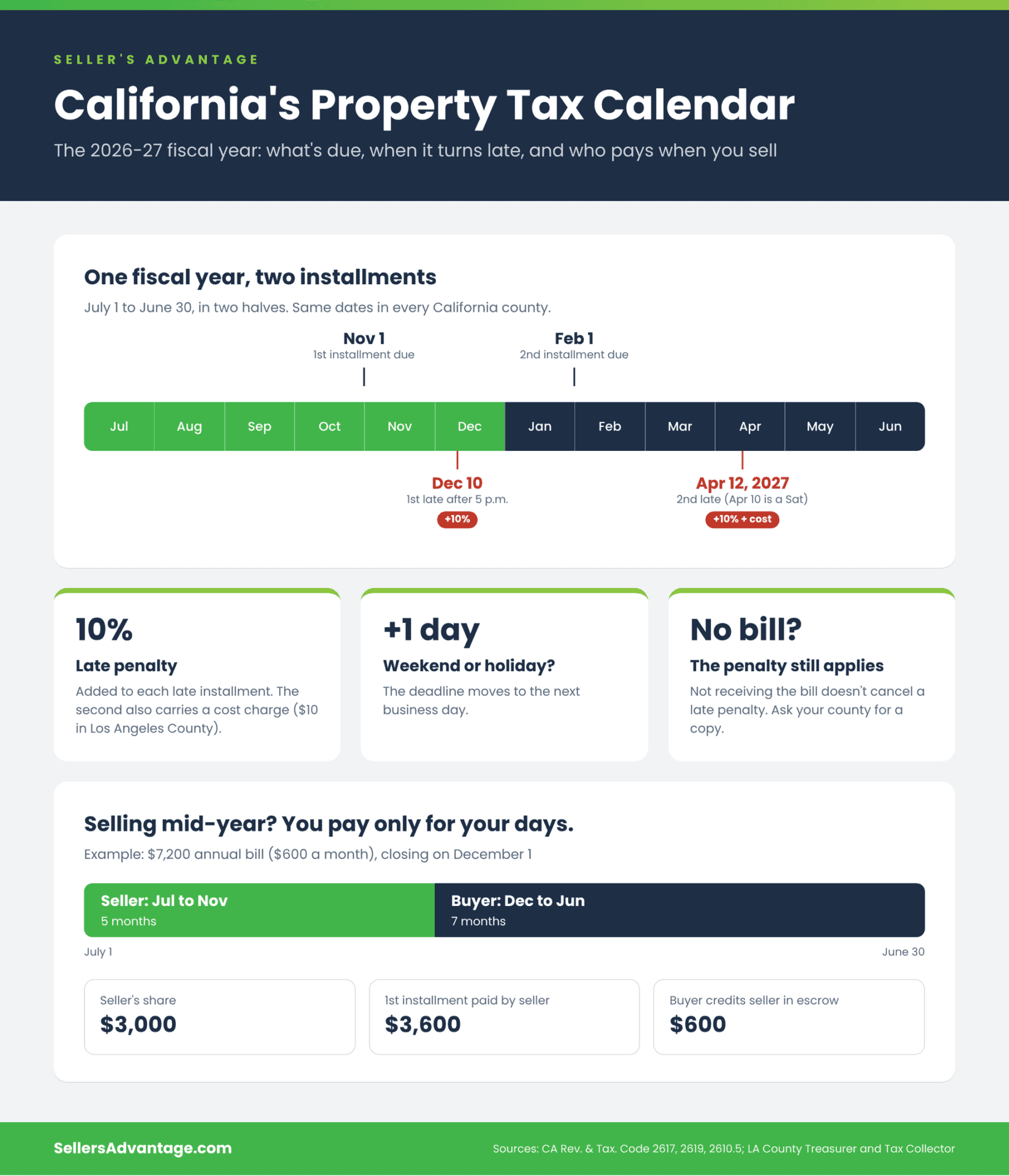
California property taxes run on a fiscal year, a 12-month budget year that starts July 1 and ends June 30. Your annual property tax bill covers that whole year for your real property, meaning the land and the house on it. The bill splits into two payments called installments.
County tax collectors mail tax bills each fall, usually starting in October. State law requires every county to send them by November 1. If yours hasn’t shown up by then, you can request a copy from your county tax collector’s office or website.
The schedule comes from state law, so every county in the Golden State uses the same dates. That includes Los Angeles, Orange, Riverside, San Bernardino, San Diego, and Ventura counties.
|
Installment |
Due date |
Late after |
|---|---|---|
|
First installment |
November 1, 2026 |
Close of business Thursday, December 10, 2026 |
|
Second installment |
February 1, 2027 |
Close of business Monday, April 12, 2027 |
|
Two words on the bill matter. Due means you can pay now. Delinquent means the deadline has passed and a penalty applies. Under Revenue and Taxation Code section 2617, the first installment turns delinquent at 5 p.m. or the close of business, whichever is later, on December 10. |
|
|
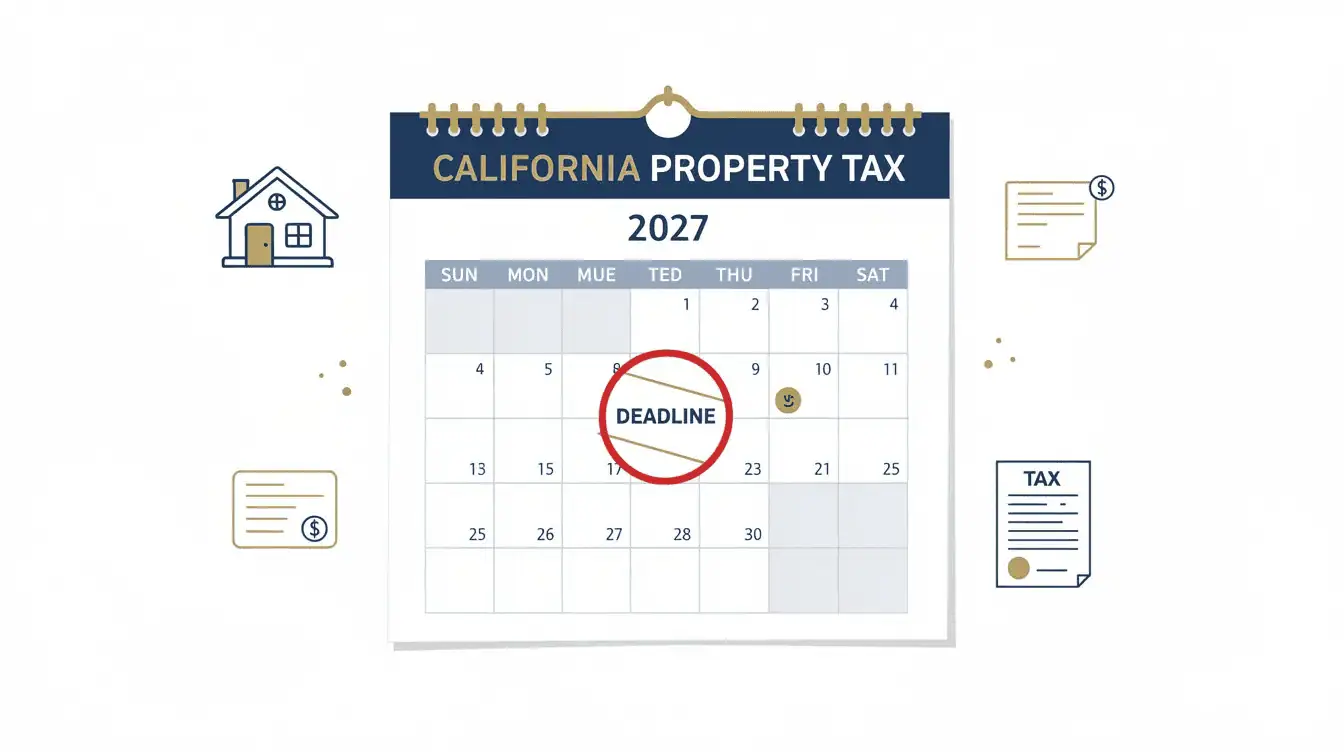
The second installment’s date looks odd for a reason. April 10, 2027 falls on a Saturday. When a deadline falls on a weekend or holiday, section 2619 moves it to the next business day. The Los Angeles County Treasurer and Tax Collector’s 2026-27 bill notice confirms Monday, April 12.
You can also pay early. Paying both installments together by December 10 leaves you only one date to track.
One note on mailed payments: they count by their postmark. Online bill pay from your bank often isn’t postmarked at all, so the county goes by the day the payment arrives. The LA County tax collector explains which mail gets postmarked. Paying on the county’s own website avoids that problem. In Los Angeles County, an electronic check payment from your bank account is free, and online payments count until 11:59 p.m. on the deadline. Los Angeles County also lets you sign up for email reminders, which makes it easier to stay ahead of the next due date.
What a Late Penalty Costs
A late first installment picks up a 10% penalty. A late second installment picks up 10% plus the applicable cost charge. Los Angeles County charges $10. State law allows counties up to $55, so check your own county’s bill for its fee.
In Southern California, 10% is rarely pocket change. Home values are high, so installments are large. For example, a $3,500 installment that’s paid late comes with a $350 penalty.
Not getting the bill doesn’t stop the penalty. Section 2610.5 says so directly, and the LA County penalty cancellation page lists what it won’t accept. Being new to the house, or not understanding the process, is on that list. So is a tight month.
Some reasons do qualify. Under section 4985.2, a tax collector may cancel penalties when something beyond your control caused the missed payment. LA County’s eligible examples include an unexpected hospital stay on the due date, a natural disaster, and the death of the owner of record, meaning the person named on the deed. If a family loss is why the bill sat unopened, it’s worth submitting a request on the county website. We’ll guide you through this tough time one step at a time, and that request is a good first step.
A missed installment is not the same as tax default. Default starts after June 30, when unpaid taxes roll into a separate process with its own interest and timeline. At that stage the unpaid amount works like a tax lien, a legal claim the county holds against the property. We cover that in our guide to selling a house with a tax lien in California.
For most sellers, though, the real question isn’t the penalty. It’s who pays which half.
How Escrow Splits the Bill When You Sell
Escrow is a neutral third party that sits between buyer and seller. It holds the money and the signed papers until everyone has done what the contract requires. At closing, the day the sale becomes final, the buyer wires the purchase money to the escrow company. Escrow pays off your mortgage and any other liens on the house. It also pays any property tax that’s due. Whatever is left goes to you. Your part is signing documents. You never send a wire yourself.
Inside escrow, taxes get prorated. Proration means splitting a bill by how long each person owned the home during the fiscal year. You pay for your days of ownership. The buyer pays for theirs. The LA County tax collector notes that this split happens between buyer and seller, not through the county.
The exact method lives in your purchase agreement, the signed contract for the sale, and in the escrow instructions. Many California escrows count every month as 30 days. Others count actual calendar days. Ask your escrow officer which one your file uses.
A worked example makes it concrete. Say your annual property tax bill is $7,200, so each installment is $3,600. That’s $600 a month. You close on December 1, so you owned the home July through November.
|
|
Amount |
|---|---|
|
Your share (5 months x $600) |
$3,000 |
|
First installment already paid by you |
$3,600 |
|
Buyer credits you for December |
$600 |
|
If you hadn’t paid the first installment yet, escrow would pay the full $3,600 from the sale money. The buyer would still credit you $600 for December. Either way, you end up paying for your five months and no more. |
|
Many homeowners make property tax payments through an impound account. That’s an account where your lender collects part of each monthly payment to cover taxes and insurance. Ask your lender whether it already paid the installment. When your loan is paid off, federal rules require the servicer to return any leftover impound balance within 20 business days. That rule is in 12 CFR 1024.34.
The math is simple when closing lands neatly. It gets trickier when the sale and December 10 overlap.
When Your Sale Straddles December 10
This is where most tax surprises happen. Your sale is pending, and the deadline is coming before closing.
Escrow can’t pay a bill before it closes. If your closing is set for December 18, the installment is late a week before escrow has any money to send. Nothing pays it automatically in the meantime.
You have a few ways to handle it. The simplest is to pay the first installment yourself by December 10. Escrow then credits you back for the part that belongs to the buyer. The other option is to let it go unpaid and resolve it at closing. In that case, the 10% penalty comes along with it.
Who absorbs that penalty depends on your contract. In practice, it usually falls on whoever owned the house and left the bill unpaid. Ask your escrow officer in November, not December, so there’s time to decide.
The installment will also show up on your preliminary title report. That’s an early summary the title company prepares, listing everything recorded against the property. An unpaid installment doesn’t block the sale. It just becomes one more line paid at closing.
Delays add another wrinkle. If closing slides past December 10, a plan that was safe in October may not be anymore. Keep an eye on the date whenever the schedule moves.
Once you’ve closed, a different kind of bill can show up.
The Bill That Arrives After You Move
Under Proposition 13, a home’s taxable value is reset to market value only after a change in ownership or completed new construction, according to the California State Board of Equalization. In between, yearly increases are generally capped at 2%.
A sale is a change in ownership. It tells the county assessor, the office that sets taxable values, to reset the home’s value as of the first day of the next month. If the new assessment is higher, the county sends the new owner one or more supplemental bills to cover the difference for the rest of the tax period.
That bill belongs to the buyer. The LA County tax collector says supplemental bills go only to the owner, even when a lender handles impounds. In Southern California this matters more than elsewhere. A home bought decades ago often carries a low taxable value, so the reset can be large. If you’re the seller, it isn’t your bill.
Sometimes the regular annual bill also arrives at your old address after closing. The county’s roll can lag behind a sale. Check your settlement statement, the itemized list of every charge and credit at closing. If the installment was paid or credited there, pass the bill along to the buyer or your escrow officer. Keep that statement with your tax records.
With those pieces in place, you can plan your timing around the calendar instead of reacting to it.
Timing Your Sale Around the Tax Calendar
If you list with a real estate agent, the calendar is harder to control. Homes often spend 90 to 120 days on the market, then 30 to 60 days in escrow. A listing that starts in late summer may close in winter, so plan for both installments. We walk through each stage of a cash sale in the cash sale process, step by step, including how a sale in as little as 7 days works from start to finish.
A cash sale gives you more say over the closing date. You can close before December 10 and have escrow pay the installment. You can also close in January after paying it yourself. Read more about how cash home buyers work and how to sell your property fast for cash in Southern California.
Either way, the rule is the same. Pay for the days you owned the home, and know who is covering the next installment before the deadline arrives. Timely payments keep your property tax obligations simple, whether you sell this year or not.
Sellers ask us a few versions of this question again and again.
Questions Sellers Ask About Tax Timing
If I pay the first installment and close in January, do I get money back? No. You’ve paid July through December, and you owned the home into January. You’ll owe a small amount for your January days, taken out at closing.
Does escrow pay my property taxes automatically? Only what’s due and listed on your settlement statement at closing. Anything due before closing is still yours to handle.
My parent died and the bill went unpaid. Is the penalty permanent? Not always. The death of the owner of record on or before the deadline is one of the reasons LA County lists for possible cancellation. Ask your county tax collector, and have the death certificate ready.
What if a deadline lands on a holiday? It moves to the next business day, the same as a weekend.
Will a late installment stop my sale? No. It gets paid at closing with the penalty added.
Who pays the supplemental bill after the sale? The buyer.
Every sale lands somewhere on this calendar. Knowing where yours falls is most of the work.
Where Seller’s Advantage Fits
If you’d like a simpler path through a sale, we buy homes as-is across Southern California. As-is means you sell the home in its current condition, with no repairs first.
Once our team has seen the home, in person or by video, a no-obligation cash offer may reach you within 24 hours. Because we pay cash, the sale carries no contingencies you’d find in a traditional mortgage loan. Contingencies are conditions that let a buyer back out, such as a loan falling through. We also don’t charge a commission, the percentage fee an agent usually takes from the sale price.
On our purchases, we cover escrow fees, title insurance, transfer fees, and recording fees. Your mortgage payoff, recorded liens, and unpaid property taxes come out of your proceeds at closing.
You choose the closing date. It can be as early as 7 to 14 days. If you’d rather close after the new year, or after you’ve paid a December installment, we’ll set the date further out. We won’t rush you out of your home.
If a bill like the December installment comes due before closing, ask about our cash advance. On cash purchases, you may be able to take up to $20,000 from your proceeds ahead of closing. That amount comes out of your proceeds when the sale closes. You’re not borrowing anything, and no fee is added. It’s there to help you start your next chapter.
And if a traditional listing would leave you with more after costs, you’ll hear that from us first.
Talk through your timing with our team →
Sell Your House Fast For Cash
We Buy Houses in Southern California As-Is
Close on your timeline and avoid the hassle of traditional fees.
Get My Free,
No-Obligation Quote
Call us today at 800-208-3243 and get an offer in as little as 24 hours. It’s quick and easy!
"*" indicates required fields
Southern California’s Most Trusted Home Buyers

