

If your home is worth less than what you owe, you’ve probably run into the phrase short sale by now. Falling behind on payments happens, and it doesn’t mean you’ve done anything wrong. Income drops, costs climb, or a payment resets higher, and the math stops working. None of that says anything about who you are. What helps right now is a clear picture of how this works.
We’re Seller’s Advantage, a family-owned real estate solutions company in Southern California. We’re a licensed California brokerage, and we buy homes directly from owners as part of our broader program to purchase homes and other property for cash in major metro areas. We also list them. If listing your house or asking your lender for a loan change would leave you better off, we’ll say so. Our California-based team at Seller’s Advantage exists to walk you through those choices.
One note before the details. This is general education, not tax or legal advice. A short sale is one of the few housing decisions where a signature can create a tax bill, so bring in a CPA and an attorney before you sign. Start with what the term actually covers.

What a Short Sale Actually Means
A short sale is a sale for less than your mortgage balance, approved in writing by your lender. The lender releases its claim on the house and accepts less than the full payoff.
Two things have to be true. Your lender has to agree. You also have to show a real financial hardship, such as lost income, a medical event, or a payment you can no longer carry.
Owing more than the home is worth has a name. Lenders call it being underwater, or having negative equity. Both mean the loan balance is higher than what the house would sell for today.
Before you assume you are there, get a real number. A local agent can prepare a comparative market analysis, which is a written value estimate built from recent nearby sales. A formal appraisal costs money and carries more weight. Online estimates are only a starting point. Plenty of owners who expect a shortfall find out they have equity after all.
If the numbers confirm a gap, the next question is whether your lender will sign off.
Why Your Lender Has to Agree
You’re asking a lender to accept a loss. That makes the review a real underwriting decision, not a formality.
Most servicers ask for a hardship letter, which is a short written explanation of what changed in your finances. They also want recent pay stubs or other proof of income, bank statements, tax returns, and a signed offer from a buyer.
A second loan or a home equity line of credit, which is a second loan secured by the house, adds another approval. Both loans are liens, meaning legal claims recorded against your property. Every lienholder has to release its claim before ownership can transfer.
Gathering all of that while you’re already stressed is the hard part for most people. Doing it once and doing it completely is what moves the review along.
Plan on weeks rather than days. Two lienholders usually stretches that out. Approval letters also expire and arrive with conditions attached, so read yours closely with your attorney.
The approval letter matters for another reason, which brings us to taxes.
The Federal Tax Break Ended in 2026
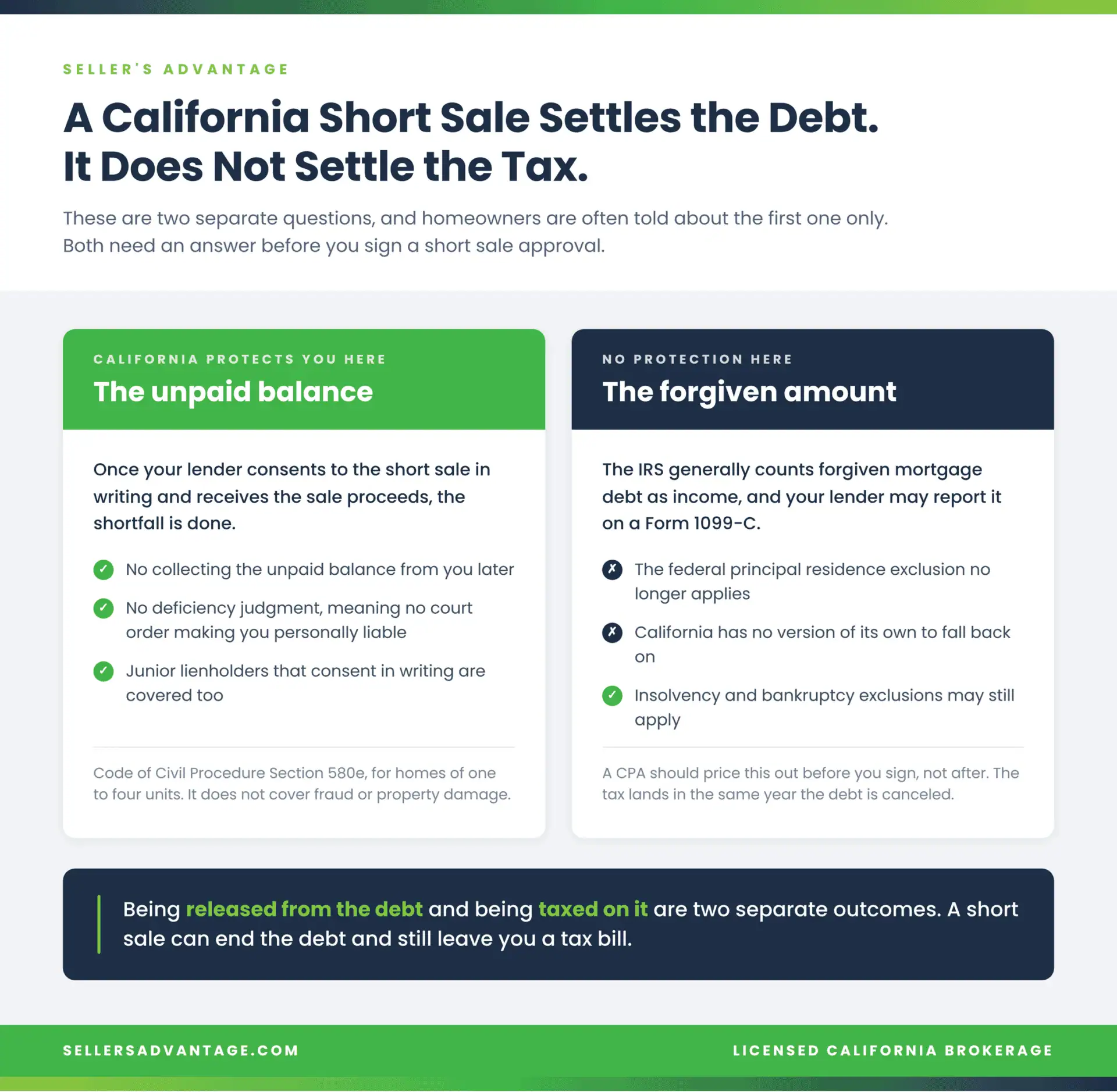
When a lender forgives part of what you owe, the IRS generally counts the forgiven amount as income. Your lender may send you a Form 1099-C, which reports canceled debt to you and to the IRS.
A federal exclusion used to protect most homeowners from that result on a main home. It no longer applies. Qualified principal residence debt cannot be excluded for discharges completed, or written discharge agreements entered into, after December 31, 2025, according to IRS Publication 4681.
California has no version of its own to fall back on. State law has been out of conformity with the federal exclusion since 2014, which the Franchise Tax Board confirms.
Two other exclusions are permanent and may still apply. Debt canceled inside a bankruptcy case is not treated as income. If you were insolvent right before the cancellation, meaning your debts were larger than everything you own is worth, part or all of the forgiven amount may be excluded. Both are claimed on IRS Form 982.
Take this to a CPA before you sign a short sale approval, not after. The forgiven balance can run into six figures, and the tax lands in the same year the debt is canceled.
None of that makes a short sale the wrong choice. It means the number needs to be known before you agree to anything.
Congress has restored this break several times in the past. Nothing has been enacted for 2026 as of this writing, so plan around the rule as it stands today.
Whether the Lender Can Come After You Later
The unpaid part of the loan after a sale is called a deficiency. Whether a lender can collect it is a separate question from the tax bill, and California answers it in your favor.
California Code of Civil Procedure Section 580e covers homes of one to four units. When your lender consents to the short sale in writing and then receives the sale proceeds, it cannot collect the shortfall from you afterward. It also cannot seek a deficiency judgment, meaning a court order making you personally liable for the balance. Junior lienholders that consent in writing fall under the same protection.
The protection has limits. It doesn’t cover fraud, and it doesn’t cover waste, which means damaging the property before you leave.
Ask your attorney to confirm that your approval letter releases you from the remaining balance in writing. Not owing the money is a separate matter from how it gets taxed. Timing matters just as much, especially if your lender has already started the foreclosure clock.
Where Foreclosure Fits In
Many short sales happen while a foreclosure clock is already running. Knowing the timeline takes some of the fear out of it.
Your servicer generally cannot record a Notice of Default until 120 days have passed since your first missed payment. That federal waiting period exists so you have room to work something out. The Notice of Default is the recorded document that opens the formal process.
Most California foreclosures never reach a courtroom. A trustee runs the process under the deed of trust, the document that secures your loan against the property. That’s why the state is called a non-judicial foreclosure state.
While a complete application for a foreclosure prevention option sits under review, your servicer generally cannot move the foreclosure forward. That protection comes from the California Homeowner Bill of Rights, and it is usually called the ban on dual tracking. A short sale request counts as one of those applications.
You can also reinstate the loan up to five business days before the scheduled trustee sale. Reinstating means paying the past due amounts plus fees to bring the loan current.
Chapter 13 bankruptcy triggers an automatic stay, a court order that pauses collection efforts. It buys time rather than solving the underlying problem, and it carries consequences for years. Speak with a bankruptcy attorney before you file.
A HUD-approved housing counselor can walk you through every option here at no cost. They have no financial stake in what you choose.
Nobody can promise you a foreclosure will stop, and we won’t pretend otherwise. Our guide for homeowners behind on a mortgage walks through the full timeline in more detail.
Options Worth Checking First
A short sale is not the only path when payments get hard, and it is rarely the fastest one.
A loan modification changes the terms of your existing loan, often by lowering the rate or stretching out the term. Forbearance pauses or reduces payments for a set stretch of months, with the paused amount repaid later. A repayment plan spreads what you missed across future payments.
A deed in lieu of foreclosure transfers ownership back to the lender instead of selling. It’s a legal step with tax and credit effects of its own, so run it past an attorney first. Owners who have already tried listing without success may also want to compare these options to selling a California house that’s already on the market.
Renting the house out covers the payment for some owners. California gives tenants some of the strongest protections in the nation. Understand what you take on as a landlord before you hand over keys, especially if you may eventually need to sell California real estate after you move away.
Selling normally is still worth pricing out. Owners often find the gap is smaller than they feared, and covering a small shortfall in cash at closing avoids the lender approval process entirely, but be aware of the challenges that come with selling your home as-is through a traditional listing.
How a Short Sale Compares With Selling As-Is
A traditional listing in Southern California often runs 90 to 120 days on the market, plus another 30 to 60 days to close. Add lender review on top of that for a short sale.
Escrow is a third party that holds the money and the documents until a sale closes. The buyer wires the purchase funds there. Escrow then clears the mortgage, plus any recorded liens and past due property taxes. Whatever remains goes to you. You never wire anything yourself. In a short sale there is usually nothing remaining, because the lender is already taking less than it is owed.
An as-is sale means selling the house in its current condition, with no repairs on your end. A cash version of that skips showings and buyer financing too. Offers come in below what a fully repaired home fetches on the open market, because the buyer takes on the repairs and the risk. What matters is the net. Once commissions, repairs, and months of carrying costs come out of a listing, the difference between the two paths is often smaller than the headline numbers suggest, which is why many owners compare this directly with fast cash home buyers in California and nearby markets.
A cash buyer can be the buyer in a short sale. The lender still has to approve the price, so the timeline belongs to the lender either way. If that path interests you, this is how it works on our end and how our sell my house fast, as-is for cash service typically plays out for Southern California owners.
What Working With Us Looks Like
Everything starts with a conversation about where you actually stand. If it makes sense to keep going, a local team member walks the property, usually within a day or two. Once that walkthrough happens, a no-obligation cash offer may follow within 24 hours of that visit. We price a house only after seeing it in person, never off a web form, which is the same approach we use as a cash home buyer in Los Angeles.
The closing date is yours to pick. Some sellers reach closing as early as 7 to 14 days. Others need a month or more, and we can extend the timeline to fit. We won’t rush you out of your home, and owners who need to move on a tighter schedule can look at our option to sell your house for cash in as little as 7 days.
We don’t charge a commission, and there are none of the contingencies you would find in a traditional mortgage loan. If your sale needs lender approval, we work on that timeline and stay in contact with your servicer, leveraging the same streamlined approach we use as a company that buys houses in any condition for cash.
We’ll also tell you when we’re not the right answer. If a listing or a loan modification would put more money in your pocket, that is what you should hear from us. When speed and simplicity matter most, our process for selling your property fast for cash is built around those priorities. A few things come up in almost every one of these calls.
Questions We Get About Short Sales
Do I have to be behind on payments to qualify? Not always. Many servicers want documented hardship rather than missed payments, and some will review a request from a current borrower. Ask your servicer what its loss mitigation department requires. That’s the team handling alternatives to foreclosure.
How long does the whole thing take? Longer than a standard sale. Lender review runs weeks, and a second lienholder adds more. Your buyer has to be willing to wait.
Will this hurt my credit? Yes, though how much depends on your history and how the servicer reports the account. Ask in writing how the debt will be reported once it is settled.
Do I get any money at closing? Almost never. The lender is accepting a loss, so it rarely approves proceeds going to the seller. Some relocation assistance programs are an exception, and your servicer can tell you whether one applies to your loan.
Can I still do this with two loans on the house? Yes, but both lenders have to sign off, and the second one has the least to gain. Build extra time into your expectations.
What if I owe taxes on the forgiven amount? A CPA can tell you whether the insolvency or bankruptcy exclusion applies to your situation. That conversation belongs before you sign the approval, because the amount is often large.
None of this has to be decided today.
Talk It Through Before You Sign
A short sale might be the right choice for you, but so might a loan modification, a straightforward listing, or even an as-is cash sale. What really matters is understanding which option fits your situation and your numbers before time runs out and the decision gets made for you, including whether it makes sense to sell your house without a realtor to a direct buyer.
If you’d like a second opinion on what your home could truly sell for, we’re here to chat anytime, with absolutely no pressure or obligation.
Talk with our local team about your situation →
Sell Your House Fast For Cash
We Buy Houses in Southern California As-Is
Close on your timeline and avoid the hassle of traditional fees.
Get My Free,
No-Obligation Quote
Call us today at 800-208-3243 and get an offer in as little as 24 hours. It’s quick and easy!
"*" indicates required fields
Southern California’s Most Trusted Home Buyers

