
Maybe it started with a fence. Or a driveway you both use, a tree that hangs over the line, or a letter from your neighbor’s attorney. Now you want to sell, and the disagreement is in the way. It’s easy to feel stuck between a buyer you haven’t met and a neighbor you’d rather not face again.
Property line and access fights are common among homeowners, and they don’t mean you did anything wrong. In older Southern California neighborhoods, many walls and fences went up decades ago without anyone measuring the legal line. On lots this close together, a few feet can matter a lot. Hillside homes add shared driveways and private roads to the mix.
You can still sell a house with an easement dispute, a boundary question, or a neighbor who won’t budge. The path that fits you turns on what kind of dispute you have and how it touches your property rights.
We’re Seller’s Advantage, a family-owned company that has spent years buying houses across Southern California. We’re also a licensed California brokerage, so listing your home is one of the paths we can take together. If a traditional sale would leave you with more money once the dispute is settled, we’ll tell you that. This is general information, not legal advice, so a real estate attorney should weigh in on your facts.
Three Problems That Look Like One
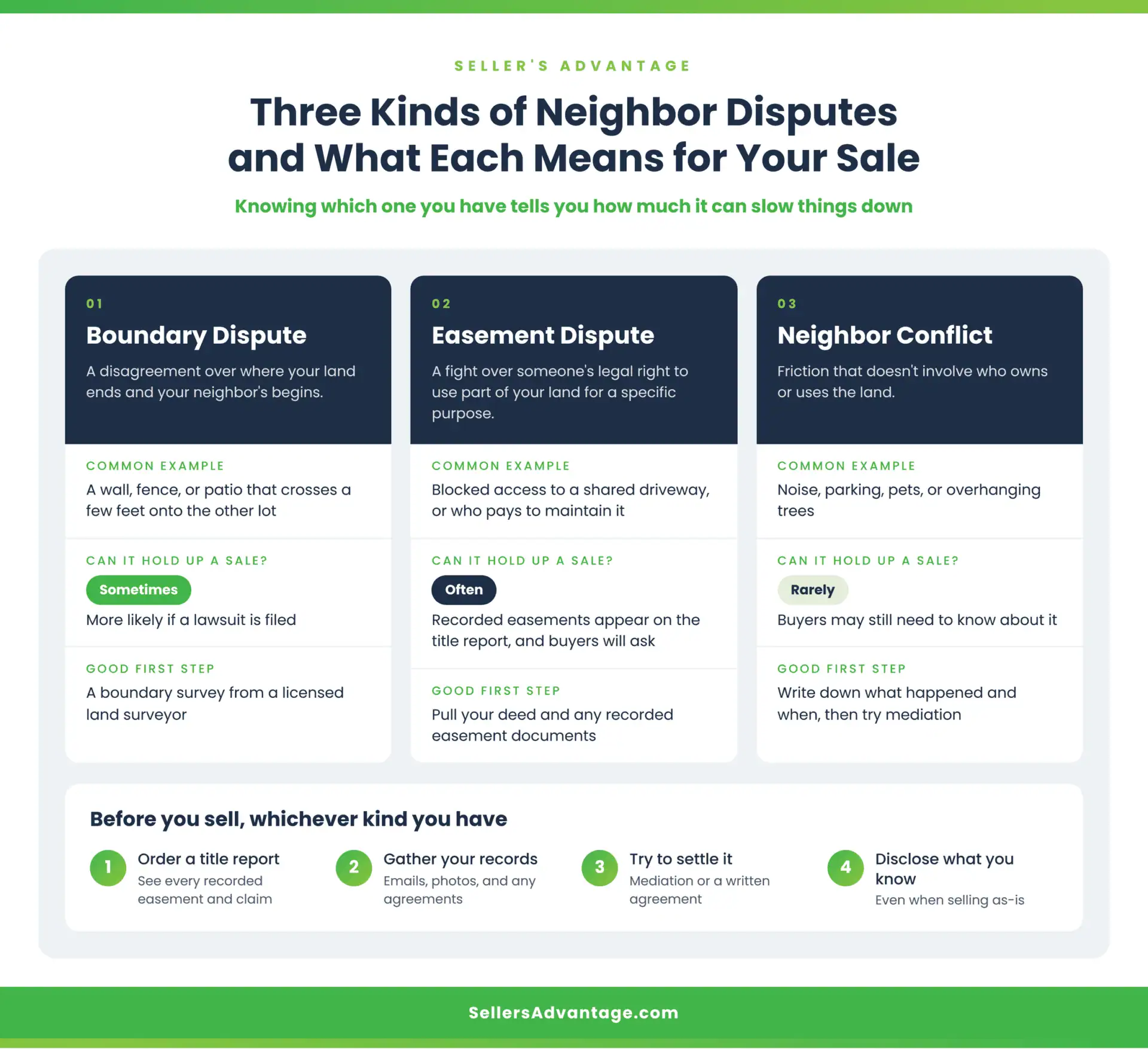
When a neighbor problem lands on top of a sale, it can all feel like one big mess. It usually isn’t. Most disputes fall into one of three groups.
Boundary disputes are arguments over where your land ends and your neighbor’s property begins. Many involve an encroachment, which means something built on one lot crosses onto the other.
Easement disputes involve a legal right to use someone else’s land. Easement disputes involve a legal right allowing someone to use a part of another person’s property for a specific purpose, such as a shared driveway. The person or entity holding these rights is known as the easement holder.The easement holder is whoever has those easement rights. California law recognizes many kinds, from a right-of-way to the right to receive water from land (Cal. Civ. Code § 801).
Neighbor conflicts cover everything else, from noise and parking to a neighbor who is simply hard to live next to. These rarely touch your legal ownership, though a buyer may still want to know about them.
Easement issues cause the most confusion, so they’re worth a closer look.
How Easements Get Tangled
If you’ve never read an easement, you’re in good company. Most homeowners only learn one exists when a problem comes up.
Many private easements are created in a deed or other easement documents recorded with the county. An easement appurtenant is one tied to a neighboring lot. It benefits whoever owns that lot and passes along when the lot sells. Utility easements work a little differently. They let a utility company reach power lines or water pipes that cross private land.
Other easements arise from long use. In California, a neighbor can gain a prescriptive easement, which is a right of use earned over time. They must use your land openly and continuously for five years without your permission (CACI No. 4901). Use you allowed usually doesn’t count. Adverse possession, a claim to actual ownership through long use, is much harder to win. The person must also have paid the property taxes on that land for five years in a row (Cal. Code Civ. Proc. § 325).
Certain easements limit what an owner can build. A conservation easement, for example, can restrict development to keep land in a natural or open condition (Cal. Civ. Code § 815.1).
Common easement disputes tend to follow a few patterns:
- Blocked access, when one party parks, fences, or builds across a shared path
- Maintenance obligations, when the two parties disagree over who pays to fix a shared driveway
- Use that goes past the easement’s specific purpose, like a footpath that turns into a parking spot
- Unclear access rights, when the easement documents are old, vague, or missing
Knowing which kind of problem you have tells you how much it can slow a sale.
When a Dispute Clouds Your Title
If you’re afraid the dispute could stop a sale cold, the answer turns on whether it affects your title.
Title is your legal property ownership. A cloud on title is any claim or document that casts doubt on that ownership, and California courts can be asked to clear one (Cal. Code Civ. Proc. § 760.010).
The biggest cloud usually comes from litigation. When someone takes legal action over rights to a property, they can record a lis pendens with the county (Cal. Code Civ. Proc. § 405.20). A lis pendens is a public notice that a lawsuit over the property is pending. Anyone who buys after it’s recorded takes the home subject to how the case turns out (Cal. Code Civ. Proc. § 405.24). That’s why many buyers and lenders stop until it’s resolved or removed.
Title insurance protects a buyer or lender against certain ownership problems in property transactions. The California Department of Insurance explains that a standard policy mainly covers defects found in public records. Extended coverage is what reaches unrecorded easements, encroachments, and boundary conflicts. A lender that spots an open dispute may simply decline to fund the loan.
Even when a dispute never shows up in public records, you still have to tell buyers about it.
What You Owe a Buyer
It’s tempting to hope a quiet dispute stays quiet through closing. California’s disclosure rules don’t leave room for that. Most home sellers in the state fill out a Transfer Disclosure Statement, the state form where a property owner tells the buyer what they know about the home (Cal. Civ. Code § 1102.6).
The form asks directly about several things that come up in neighbor disputes:
- Walls, fences, and driveways you share with a neighbor
- Easements, encroachments, or anything similar that could affect your ownership
- Noise or other nuisances in the neighborhood
- Lawsuits by or against you that affect the property
The standard is what you know. If you know about the dispute, you disclose it. That holds even when you sell as-is, meaning in its current condition with no repairs. Our guide to selling a house with an unpermitted addition covers how that knowledge standard works. A short, factual note is usually enough, and an attorney can help you word it.
Before you write anything down, it helps to know exactly what you’re dealing with.
Get the Facts on Paper First
A dispute can feel like your word against your neighbor’s. Documents change that.
Start with a preliminary title report from a title company. It lists every recorded easement, lien, and restriction on your property. A lien is a legal claim against the home for money owed. Ask for copies of any easement documents and your deed, since they spell out who has the legal right to use what, and review resources on selling a house without a realtor if you’re considering handling the process yourself.
Next, think about a boundary survey. A licensed land surveyor measures your lot and marks the legal lines. You can check a surveyor’s license with the Board for Professional Engineers, Land Surveyors, and Geologists. When the line is unclear, a survey helps determine where it really sits, and many neighbor fights cool down once both sides see it.
Then gather your own records. Save emails, texts, letters, and photos, and note when the problem started. If you’ve let a neighbor use part of your land, note when and how you gave permission.
With the facts in hand, you can decide whether to settle the dispute before you sell.
Ways to Settle It Before You List
Nobody wants a home sale to turn into a second job managing a feud. Many disputes can be settled without a courtroom, and settling one often brings more buyers back to the table.
Talk, then mediate. A mediator is a trained, impartial person who helps both sides reach an agreement. Los Angeles County’s Dispute Resolution Program takes neighbor disputes over boundaries, fences, and trees, and describes its services as free or low-cost. Other counties run community mediation programs too.
Put the deal in writing. If you and your neighbor agree, an experienced attorney can draft the terms. The agreement might set the line, grant a formal easement, or spell out maintenance obligations for a shared driveway. Recording it with the county lets a future buyer see exactly what’s settled. If a neighbor uses your land with your blessing, written permission can also help keep that use from becoming a prescriptive easement (Cal. Civ. Code § 813).
Move the lot line. When a wall or structure sits on the wrong side, neighbors can sometimes shift the line itself. California allows a lot line adjustment between neighboring parcels once the city or county approves it (Cal. Gov. Code § 66412(d)). Local land use rules still apply, it takes time and fees, and approval isn’t automatic.
Go to court last. A quiet title action asks a judge to decide who owns what and to clear the cloud for good. It can take many months and real legal fees, so most people try everything else first.
Some sellers can’t wait for any of this to finish, and that’s where your selling options come in.
Choosing How to Sell
Maybe you’re tired and want this to be someone else’s problem. That’s fair, and you have more than one path.
Settle first, then list. If the dispute is small and your neighbor will talk, settling it and then listing with a real estate agent often brings the highest price. A traditional sale typically takes 90 to 120 days on the market, plus 30 to 60 days to close, and if your home is already on the MLS you may need to rethink your strategy using guidance on selling a house that’s already listed in California.
List now and disclose. You can put the home on the market with the dispute still open. Some buyers will walk away, and others will ask for a lower price because the dispute weighs on property value in their eyes. If a lis pendens is recorded, many lenders won’t fund a loan, which can leave you with only cash buyers.
Sell as-is to a direct buyer. A direct buyer purchases the home themselves instead of listing it for someone else. Some will take on an open boundary or easement question, and their offer reflects that risk. What matters is your net proceeds, the money you keep after all costs. The gap is often smaller than it looks once you count repairs, agent commissions (the fee an agent charges to sell), and months of holding costs, especially when you understand the challenges of selling a home as-is on the open market.
Wait for a ruling. If the dispute is already in court, waiting can be the right call. Waiting also means paying the mortgage, taxes, and insurance each month, sometimes from another city or state, so weigh that against what a ruling could gain you and what it would take to sell California real estate after you move away.
If a direct sale sounds like it could fit, it helps to see how one works with us and how we help homeowners who need to sell property fast for cash.
Selling to Us With a Dispute Still Open
You may wonder whether anyone will buy a home with a fight attached. We will look, and we’ll be clear about what we find. We don’t resolve legal disputes ourselves. We work alongside your attorney and the title company, and we’ll guide you through this tough time.
We see the home in person first and review the title report with you. Within 24 hours of that visit, a no-obligation cash offer may be ready for you to consider, similar to our main service for homeowners who want to sell a house fast for cash as-is. Whether we can buy while a lawsuit is still open is a case-by-case call we make with the title company.
A cash purchase comes with no contingencies you’d find in a traditional mortgage loan. Closing may be as early as 7 to 14 days after you say yes. If you need more time to plan your move, we can stretch the timeline to fit you. We won’t rush you out of your home, and our broader program for fast cash home sales in California works the same way.
At closing, an escrow company handles the money. Escrow is a third party that holds the funds and the signed documents until every term of the sale is met. We wire our purchase funds to the escrow company. Escrow then clears your mortgage and any liens and sends the remainder to you. You never wire money to anyone.
We don’t charge a commission. We also cover government fees, transfer fees, recording fees, escrow fees, and title insurance, just as we do in our statewide program to buy California houses for cash. Your mortgage payoff, any recorded liens, and unpaid property taxes come out of your proceeds at closing.
Some sellers need money before closing day, maybe for a deposit or movers. On a cash purchase, you can ask for up to $20,000 early to help you start your next chapter. It comes out of your own proceeds at closing, so it isn’t a loan and it carries no added fee, and our Seller’s Advantage team walks you through how it works.
You probably still have a few questions. These are the ones we hear most.
What Sellers Ask Us About Property Line Fights
Can my neighbor stop me from selling? Usually not. You own your home and can sell it. A recorded lis pendens can make buyers and lenders hesitate, though, and an attorney can tell you whether there are grounds to ask the court to remove it.
Does an easement go away when I sell? Usually not. California law says a sale passes along the easements attached to the property (Cal. Civ. Code § 1104), and a recorded easement across your lot usually binds the next owner too. An easement can terminate in a few other ways, such as when one owner ends up holding both properties (Cal. Civ. Code § 811).
How do I know if it’s a valid easement? Start with your title report and deed. A recorded easement will usually appear there. An easement claimed through long use won’t, and only a court can confirm one.
Do I have to disclose an argument that never went anywhere? If it was about the property, like a shared wall or where the line sits, lean toward disclosing it. A personal spat with no link to the land is different, and an attorney can help you tell the two apart.
If your question isn’t on this list, we’re happy to answer it directly or you can review how we buy houses fast in Los Angeles and the rest of Southern California.
Whenever You Want a Second Opinion
A neighbor dispute can make your own home feel like it isn’t fully yours. You don’t have to sort it out alone. We’ll guide you through it, whether that means a cash sale, a listing, or advice to settle first and sell later, just like you may have seen in our Seller’s Advantage TV commercials.
If you’d like to know what your home could bring as it stands today, we’re glad to take a look. There’s no pressure and no obligation.
Contact our team about your home and the dispute →
Sell Your House Fast For Cash
We Buy Houses in Southern California As-Is
Close on your timeline and avoid the hassle of traditional fees.
Get My Free,
No-Obligation Quote
Call us today at 800-208-3243 and get an offer in as little as 24 hours. It’s quick and easy!
"*" indicates required fields
Southern California’s Most Trusted Home Buyers

