
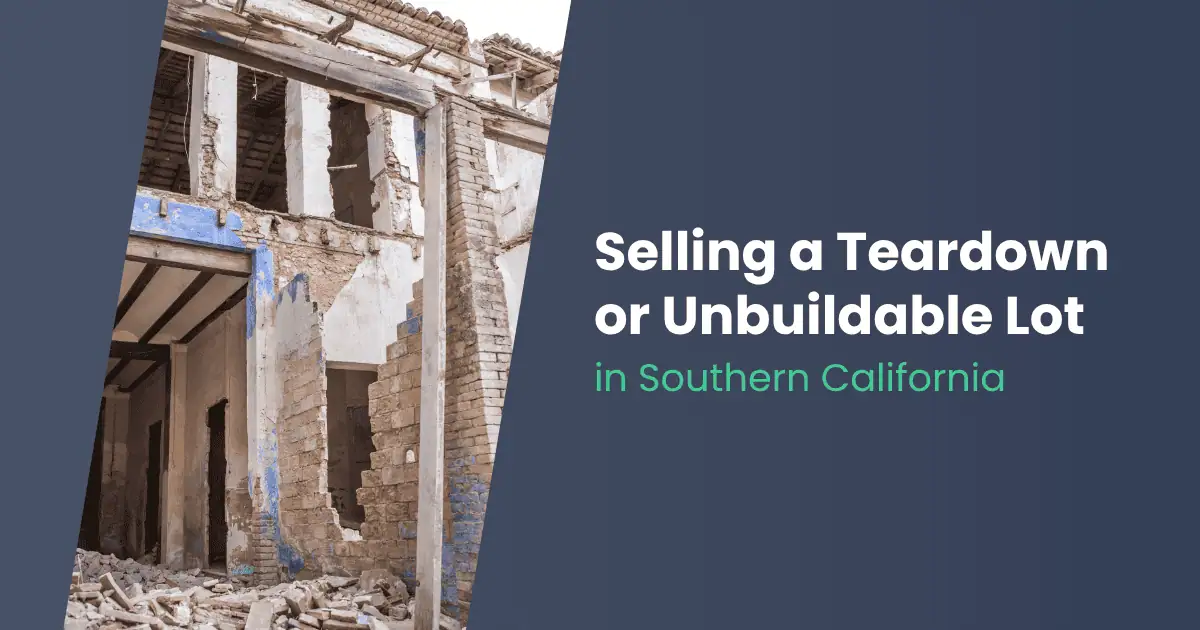
A contractor, an inspector, or maybe a city planner has used the word “teardown” about your property by now. Maybe the roof gave out, the plumbing, or the repair bids stopped making sense. Either way, you’re still paying taxes and insurance on a place no one can live in.
Many Southern California homeowners end up here, and most have more options than they realize. California land holds value even when the old house on it doesn’t. That gap is what turns a property into a teardown, and it’s also what gives you a way out. Owners ask us how to sell an unbuildable lot in California more often than you’d think, especially in tight markets like Los Angeles where fast cash buyers are active.
We’re Seller’s Advantage, a family-owned, licensed California brokerage. We’ve bought Southern California houses in every condition, including plenty that were headed for the bulldozer, and our company story explains how we specialize in buying homes as-is for cash. If a builder or a listing agent would put more money in your pocket than we can, we’ll tell you that.

Teardown and Unbuildable Are Two Different Problems
A teardown is a house that costs more to fix than it adds to the property’s value. The land is worth something. The structure is worth nothing, or less than nothing, because the next owner has to pay to remove it. In much of Los Angeles, Orange County, and the coastal cities, a 1950s house on a good street gets bought for the ground underneath it. That’s a normal sale, just with a different kind of buyer.
An unbuildable lot is a harder case. The label means something about the land, or the rules around it, blocks a new home from going up. The usual causes:
- Zoning and lot size. The parcel is smaller than the city’s current minimum, or the zoning changed after the house was built.
- Legal nonconforming status. The existing house was allowed under old rules but couldn’t be built today. In many cities, knocking it down can erase that protection, so a replacement home may not be approved on the same footprint.
- Access problems. No legal access, meaning no road access and no recorded easement (a written right to cross someone else’s land), usually means no building permit.
- Utilities. No sewer connection, and soil that won’t pass a septic test.
- Slope, soil, and geology. Hillside lots in the Santa Monica Mountains, Laguna Beach, or the Inland Empire foothills can need geology reports and retaining walls. Those alone can cost more than the finished home would be worth.
- Hazard and coastal overlays, the extra rule layers a city applies on top of zoning. Lots in a High or Very High Fire Hazard Severity Zone can face stricter building standards, and you can look up your zone on the state fire marshal’s map. Lots inside the Coastal Zone, the state-mapped strip along the shoreline, need a coastal development permit for most work, and the California Coastal Act counts demolition itself as development.
- Deed restrictions, conservation easements, and historic designations that limit what new construction can replace the current structure.
Two points soften that list. Unbuildable usually means unbuildable under today’s rules, not forever. Sometimes the fix is a lot line adjustment or an access easement worked out with adjacent owners. And some of those rules have loosened. California’s SB 9 requires most cities to allow two units, or a lot split (dividing one parcel into two), on many single-family residential lots. The state housing department’s fact sheet notes that hazard zones and other criteria can disqualify a lot. A conversation at your city or county planning counter will tell you where your property stands. It’s free, and it changes the whole strategy.
Before you make that call, it helps to understand how the property got here, because the same forces shape what it’s worth now.

How a House Turns Into a Liability
Deferred maintenance compounds. A roof leak becomes rotted framing, rotted framing becomes mold, and mold becomes a code enforcement letter. Once a house sits empty, insurance carriers often refuse to renew, which leaves you exposed if someone gets hurt on the property or a fire starts. Cities can red-tag the structure, meaning post it as unsafe to occupy, or order it cleaned up. If the city does the cleanup, the bill can become a lien, a debt legally attached to the property, right alongside any back taxes.
None of that means you did something wrong. Repair costs in California run higher than national averages, and a house can cross from fixable to teardown within a few years of sitting empty. Many owners inherit a property already past that line, or hold onto one while life gets in the way of dealing with it.
Meanwhile the taxes, weed notices, and insurance bills keep arriving, and each one eats a little of the land’s value. So the first job is to find out exactly what you’re holding.
Find Out What You Actually Own Before You Decide
Four steps, none of them expensive, most doable in a week, especially when you’re working with a local team that specializes in simplifying home sales.
Order a preliminary title report. This is the result of a title search: a document from a title company that confirms ownership and lists every recorded lien, easement, and restriction attached to the property. Any title company can order one, and a real estate agent will often pull it for free. Title issues found now are far cheaper to fix than title issues found in escrow.
Visit the planning counter. Confirm zoning first, then ask five questions: What is the current zoning? What is the minimum lot size? Is the existing house legal nonconforming? What happens to rebuild rights if it’s demolished? Is the parcel in a hillside, coastal, historic, or fire overlay? Get the answers by email. A written planning determination is worth real money to a buyer. If the lot lines are in doubt, a land survey (a licensed surveyor mapping the exact boundaries) settles it.
Get a land-value number. Ask an agent who sells lots for a comparable market analysis (a CMA, meaning a price estimate built from comparable sales of similar parcels nearby), or order an appraisal. Make sure the number is based on the land and not the house.
Hold off on demolition bids. You only need those if you’re set on tearing the house down yourself, and the next section explains why most owners shouldn’t.
Once you know what’s buildable and what the dirt is worth, the options sort themselves out quickly, and it becomes easier to decide whether a traditional listing or a quick cash home buyer like the one featured in our TV commercials makes more sense.
Every Way to Sell, Including the Ones We Don’t Do
Demolish first, then sell the lot. This sounds clean and rarely is. The South Coast Air Quality Management District, the regional air district, covers most of Los Angeles, Orange, Riverside, and San Bernardino counties. Its Rule 1403 requires an asbestos survey by a certified consultant before any demolition, no matter how new the house is. Any asbestos found has to be removed first, and the district needs notice 10 working days before work starts. State law bars your city from issuing a demolition permit until you show that notice. In the Coastal Zone, the demolition itself needs a coastal permit. And once the house is gone, you may have lost the nonconforming rights that made the lot buildable at all. You’d then need to sell land rather than a house, and an empty lot is harder to finance and draws fewer buyers. Our earlier guide to selling vacant land in Southern California covers that market, from city lots to raw acreage, and who the land buyers are. One thing to know up front: Seller’s Advantage doesn’t buy bare land. Our program is for properties with a structure still standing, even one that’s coming down.
List it as-is with a real estate agent, priced on land value. As-is means the buyer takes the property in its current condition, with no repairs from you. The agent puts it on the multiple listing service (the MLS, the shared database agents use to market properties), handles pricing, and screens out tire kickers. The buyer pool is builders, developers, and contractors. On a lot-value sale they’ll often write the offer on a vacant land purchase agreement, a contract built around feasibility rather than a home inspection. They’ll usually ask for a feasibility period, also called due diligence, a stretch of weeks where they study zoning, soils, and permits and can cancel if the answers disappoint. Expect a commission of roughly 5 to 6%. A traditional sale runs 90 to 120 days on the market plus 30 to 60 days in escrow, the closing period when a third party holds the funds and paperwork. Feasibility can stretch that further. This route fits best when the planning department has already confirmed the lot is buildable.
Renovate and sell as a home. Almost never pencils out on a true teardown. If a contractor says otherwise, get a second bid.
Keep it and wait. Some owners with cash and patience hold on, hoping rules change or values rise. The carrying costs, the liability, and the insurance problem all continue while they wait, which is why others look into selling a Los Angeles house fast for cash instead.
Sell as-is to a direct buyer while the house is still standing. No demolition, no asbestos survey, no permits on your side. The buyer takes on the survey, the teardown, and the risk that the lot is harder to build on than everyone hoped. A cash offer on a teardown sits below what a builder might pay after a long feasibility period, because the buyer absorbs those costs and that risk. What matters is your net. Many owners find the gap is smaller than expected once commission, months of carrying costs, and demolition come off the listing number, which is why some compare that route with quick cash home sales across California.
If you’re weighing those last two paths, a side-by-side view helps, especially once you understand the real-world challenges of selling a home as-is through a traditional listing.
Listing a Teardown vs. Selling It Direct
Traditional listing | Direct as-is sale | |
|---|---|---|
Who buys | Builders, developers, contractors | A licensed direct buyer |
Timeline | 90 to 120 days on market, plus 30 to 60 in escrow, plus feasibility | As early as 7 to 14 days, or longer if you need it |
Demolition and asbestos | Often negotiated onto the seller | Buyer’s responsibility |
Commission | Roughly 5 to 6% | None |
Contingencies (a buyer’s exit conditions) | Feasibility, financing, inspection | None you’d find in a traditional mortgage loan |
Best when | Lot is confirmed buildable in a strong area | Buildability is uncertain, or you need certainty and speed |
The listing route can gross more on a clean, buildable lot. The direct route removes the parts that keep owners stuck. |
What a Direct Sale Looks Like With Seller’s Advantage
It begins with a phone call about the property, what the planning department has told you, and what you need out of the sale. Then a member of our local team comes out and looks at the lot as carefully as the house, because on a teardown the lot is the asset.
Once we’ve stood on the property, a no-obligation cash offer may come within 24 hours, similar to our broader program for selling a house fast for cash as-is. We don’t charge a commission, and we pay closing costs on our side: escrow fees, title insurance, recording fees, transfer fees, and government fees. Any existing mortgage, recorded liens, and back taxes are paid from the sale proceeds.
Escrow, that same third party, is where the money moves. We wire the purchase funds to the escrow company, escrow uses them to clear your mortgage and any liens, and whatever remains goes to you. At no point do you wire money to anyone.
You pick the closing date. It can be as early as 7 to 14 days after accepting, or we can extend the timeline to fit your needs. We won’t rush you. On a cash purchase, up to $20,000 of your money can arrive before closing to help you start your next chapter, a feature we also describe in our guide on selling your house for cash in as little as 7 days. It comes out of your proceeds at the closing table, which makes it neither a loan nor an added charge.
A few questions come up on nearly every teardown call, so they’re worth answering here, and many overlap with the broader home selling FAQs we hear from California owners.
Questions Homeowners Ask About Teardowns and Unbuildable Lots
Can I sell a lot the city says I can’t build on? Yes. Fewer buyers will want it and the price will reflect the restriction, but it can sell. California law requires you to disclose what you know about the property’s condition and restrictions, so a written planning determination protects you as much as it informs the buyer. Many of the same disclosure and process points apply if you’re selling a house without a realtor to a direct buyer.
Should I tear the house down before selling? Usually not. Demolition costs money, takes permits, can erase nonconforming rights, and leaves you with vacant land that’s harder to finance and sell. The exceptions: a buyer requests and pays for it, or a city order requires it. Owners focused on timing and certainty sometimes look instead at how to sell a property fast for cash.
Is asbestos my responsibility if I sell as-is? You must disclose what you know. The survey and removal duties under Rule 1403 fall on whoever demolishes, and in a direct as-is sale that’s the buyer. Companies that buy houses in any condition for cash factor potential asbestos and demolition costs into their offers.
Could an SB 9 lot split make my property worth more? Possibly, but only if the parcel qualifies, and buyers price on what the city will actually approve. Ask a planner before you count on it. In some cases, a straightforward fast cash sale of your home in Southern California is a better fit than trying to engineer extra density.
What if the house is red-tagged or under a cleanup order? The order and any related lien get disclosed and settled in escrow like any other lien. They don’t stop a sale, and many owners in that situation look closely at reviews from other sellers who used a cash buyer to gauge what the process is actually like.
Where to Go From Here
A teardown or an unbuildable lot might feel like a big challenge, but it’s something you can work through and there’s no need to rush it. Start by giving your local planning counter a quick call, get a clear idea of your land’s value, and then come back to the options above with real numbers in hand.
If it looks like listing with an agent is the way to go, we’ll be upfront and let you know. And if selling directly with the house still standing feels like a better fit our team at Seller’s Advantage will guide you through every step at a pace that works for you.
Sell Your House Fast For Cash
We Buy Houses in Southern California As-Is
Close on your timeline and avoid the hassle of traditional fees.
Get My Free,
No-Obligation Quote
Call us today at 800-208-3243 and get an offer in as little as 24 hours. It’s quick and easy!
"*" indicates required fields
Southern California’s Most Trusted Home Buyers

