
You’re ready to sell a rental property you’ve owned for years. Your tenant pays a portion of the rent, and the housing authority pays the rest on the family’s behalf. Now you’re wondering whether that setup locks you in.
It doesn’t. It does add a second layer of rules on top of California’s tenant laws, and plenty of California landlords never needed to learn them until now. Not knowing them yet is normal. It just means you need good information before you notify anyone of anything.
We’re Seller’s Advantage, a family-owned company in Southern California. We buy houses directly, and we also list them as a licensed brokerage. We’ll guide you through the rules and every path forward, and we’ll tell you plainly which of those paths is best for you, backed by a dedicated Seller’s Advantage team.

Why It Feels Stuck
Most landlords in this spot feel boxed in by paperwork they didn’t write. That feeling makes sense, because a Section 8 rental runs on three sets of rules at once.
Section 8 is the federal Housing Choice Voucher program. It helps families with lower incomes rent homes from private landlords. The U.S. Department of Housing and Urban Development, or HUD, funds it. A local public housing agency, or PHA, runs it in your area. The PHA does an inspection of the home, sets the family’s portion of the rent, and pays you the rest.
The first layer is your lease agreement with the tenant. The second is the housing assistance payments contract, or HAP contract, between you and the PHA. That contract is how the government’s share of the rent reaches you each month. The third layer is state and local laws, which protect your tenant whether or not a voucher is involved.
To sell rental property with a Section 8 tenant, you work within all three. The next section covers what each one allows.
The Rules You’re Working With
If you’ve had the same family in the home for years, this part can feel personal. That’s fair. The rules below are about timing and notice, not about your ability to sell. As the property owner, you can sell.
Federal lease rules. A voucher lease usually starts with a first term of at least one year (24 CFR 982.309). During that first term, HUD rules don’t let you terminate the tenancy for a business reason like a sale (24 CFR 982.310). After it, a sale can count as a valid reason under federal rules. Any notice you give the tenant must also go to the PHA at the same time.
California’s just cause law. The Tenant Protection Act, often called AB 1482, kicks in once a tenant has lived in the home for 12 months. From then on, you need a legal reason, called just cause, to end the tenancy (Civil Code 1946.2). Selling the house isn’t on that list. Some no-fault reasons, meaning ones that aren’t about the tenant’s conduct, are on it. Examples include taking the home off the rental market or making it your primary residence.
A no-fault ending comes with relocation assistance, which is money to help the tenant move. Under state law, it equals one month’s rent, paid within 15 days of the notice, whatever the tenant’s income. Some homes are exempt from this law. Examples include many single-family homes and condos owned by individuals, if the lease included a specific written notice. A duplex where an owner occupant lives in the other unit can also be exempt.
Local rules. Several Southern California cities go further than the state. Los Angeles applies its Just Cause Ordinance after six months, even to many single-family homes. San Diego has its own tenant protections with separate relocation rules. Check your city’s rules before you act.
Ending the voucher contract. If you stop renewing the HAP contract, California requires at least 90 days’ written notice to the tenant. For those 90 days, the family pays only its usual portion of the rent (Civil Code 1954.535). Ending a contract with a government agency doesn’t end the lease on its own.
Fair housing. California treats a housing voucher as a protected source of income (Government Code 12955). The same law protects renters based on national origin, familial status, disability, and other traits. You can’t turn away a renter, or treat one differently, for any of these reasons.
Worth knowing: these rules overlap in ways that trip up careful owners. A landlord-tenant attorney can review your current lease and your timeline before any notice goes out. With the rules in view, you have four ways forward.
Your Four Paths
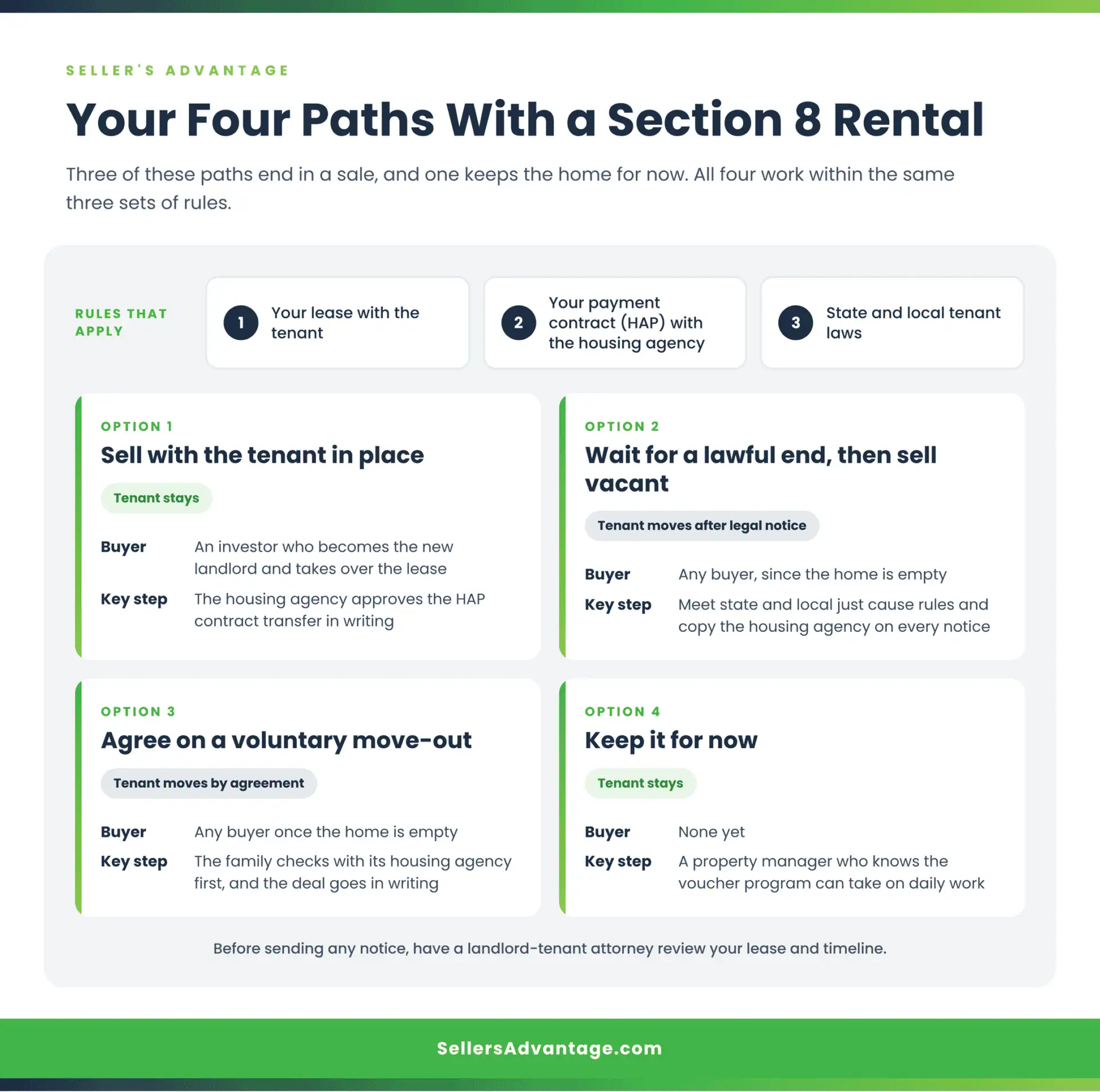
Option 1: Sell with the tenant in place. You can sell a rental while the tenant stays in the home. The buyer becomes the new landlord, assuming the current lease and all its terms. That matters most with a fixed-term lease, meaning one with a set end date. The buyer has to honor it until it ends.
To keep the voucher payments going, the buyer also needs a transfer of the HAP contract. The PHA must agree in writing first, and the new owner must agree to comply with the contract. Tell the PHA about the change in ownership early so payments don’t stall.
This path usually draws investors, meaning buyers who purchase homes to rent out rather than live in. Some are local, while others may be out of state and rely on streamlined processes for selling California real estate after moving away. The best fit already works with voucher tenants and sees the home as a steady investment. The family keeps its home, and you skip the notice process entirely.
Your security deposit duties change hands at closing, too. California requires you to either return the deposit or pass it to the buyer and tell the tenant in writing (Civil Code 1950.5).
Option 2: Wait for a lawful end, then sell vacant. If you’d rather sell an empty house, the tenancy has to end on legal grounds first. That usually means waiting out the first lease term and meeting state and local just cause rules. It also means paying any relocation assistance and copying the PHA on each notice. In return for the wait, a vacant home is easier to show, repair, or sell as-is, meaning in its current condition with no repairs.
Option 3: A voluntary move-out agreement. Some landlords offer a tenant money to move out by a set date. People often call this cash for keys. With a voucher tenant, the family’s first call should be to its PHA. HUD rules let a family move with its voucher when a lease ends by mutual agreement (24 CFR 982.354). A PHA can still deny a move, for example when funding runs short. Some cities also regulate these agreements, so put yours in writing and have an attorney review it.
Option 4: Keep it for now. Voucher rent tends to bring steady cash flow, and the PHA’s share arrives on a schedule. If day-to-day management is the real problem, a property manager who knows the program may lighten the load without a sale.
Each path leads to a different kind of sale. That difference shows up most in who buys and what you keep, especially if you decide to work with a California cash home buyer like Seller’s Advantage.
Selling Occupied vs. Vacant
An occupied rental narrows your buyer pool. Most people buying a home to live in need it empty. So a tenant-occupied house mostly draws investors, and they price in the lease, the voucher rules, and any repairs. We cover the general rules for any tenant-occupied sale in our guide to selling a tenanted property.
Showings are harder, too. California requires reasonable notice before you enter, and 24 hours is presumed reasonable (Civil Code 1954). For buyer showings, you also have to tell the tenant in writing that the home is for sale. Many tenants cooperate. Some don’t, and within the law, that’s their right.
A traditional listing, where an agent markets the home to the public, tests your price on the real market. It may bring the highest sale price, especially after repairs. It also takes time, often 90 to 120 days on the market plus 30 to 60 days to close. Repairs, the agent’s commission (a fee based on a percentage of the price), and carrying costs all come out of what you keep. Carrying costs are the mortgage, taxes, insurance, and utilities you pay while you wait.
A cash sale of a vacant home skips the repairs and the showings. The price is usually lower, because the buyer takes on the repairs and the risk. What matters is your net proceeds, which is the money you actually walk away with after every cost. Many sellers who need to sell a property fast for cash find that gap is smaller than they expected.
Before you make a plan, most landlords have a few more questions.
Questions Landlords Ask
Can I sell during the first year of the lease? Yes. You can sell at any time. What you can’t do during the first term is end the tenancy because of the sale. A buyer who takes over the lease and the HAP contract can close with the family still living there.
Does the voucher go away when I sell? No. The voucher belongs to the family, not the house. If the new owner takes over the HAP contract, payments continue. If the tenancy ends lawfully, the family can usually take its voucher to a new home with the PHA’s approval.
Can the new owner raise the rent? Not during the first lease term. After that, the owner must notify the PHA at least 60 days before any rent increase. The PHA then checks that the new rent is reasonable compared with similar units nearby (24 CFR 982.507). California’s rent caps may also apply.
Who gets the PHA’s payment for the month I sell? Tell the PHA about the sale early and ask how it handles that month. Then make sure the closing paperwork splits that month’s rent correctly between you and the buyer.
Can I just stop taking Section 8 when the lease ends? You can choose not to renew the HAP contract with 90 days’ notice. That alone doesn’t end the tenancy, and California’s source of income protections still apply. Talk to an attorney before taking this step.
What if my tenant stops paying their portion? That’s an at-fault reason, meaning one based on the tenant’s own actions. It follows a different legal process. The PHA still gets a copy of every notice.
If a vacant sale is where you land, that’s where we come in.
When the House Is Empty
We’ll start with where we don’t fit. We can’t buy a house with an active lease in place, so we aren’t the buyer for Option 1. If keeping the family in their home matters most to you, an agent who sells tenant-occupied rentals to investors may serve you better. We’ll tell you that directly, the same way we explain when selling for cash is the wrong move and outline how we buy houses for cash in as little as 7 days.
Once the home is vacant after a lawful move-out, we can buy it as-is. Someone from our team walks through the empty house with you. Within 24 hours of that visit, you may receive a no-obligation cash offer through our sell my house fast, as-is service. There’s nothing to fix or clean first, and we don’t charge a commission. Our offer also skips the contingencies a traditional mortgage loan carries. Contingencies are conditions that let a buyer back out of the deal.
You pick the closing date. It can be as early as 7 to 14 days, or later if you need time to wrap up loose ends. The calendar is yours, and we won’t rush you, whether your home is here in Southern California or in another market where we buy houses for cash.
At closing, escrow handles the money. Escrow is a third-party company that holds both the funds and the signed documents until the sale is final. We send our purchase funds to the escrow company by wire. Escrow then pays off your mortgage and any liens, which are legal claims against the property for unpaid debts, and the balance comes to you. Nothing gets wired from your side.
Sometimes the stretch between move-out and closing gets tight. On cash purchases only, you can ask us to release up to $20,000 early to help you start your next chapter. That money comes out of what you’d receive at closing anyway, so it’s not a loan, and there’s no added fee, which can matter if you’re trying to sell a house fast in Los Angeles or elsewhere in Southern California.
Whichever path you choose, we’re glad to walk you through it, even when the honest answer is that someone else is the better buyer, or when it makes more sense to sell a house without a traditional realtor.
Talk with our team about your Section 8 rental →
You can also see the markets where we currently buy homes and watch our Seller’s Advantage TV commercials to get a feel for how we work.
Sell Your House Fast For Cash
We Buy Houses in Southern California As-Is
Close on your timeline and avoid the hassle of traditional fees.
Get My Free,
No-Obligation Quote
Call us today at 800-208-3243 and get an offer in as little as 24 hours. It’s quick and easy!
"*" indicates required fields
Southern California’s Most Trusted Home Buyers

