
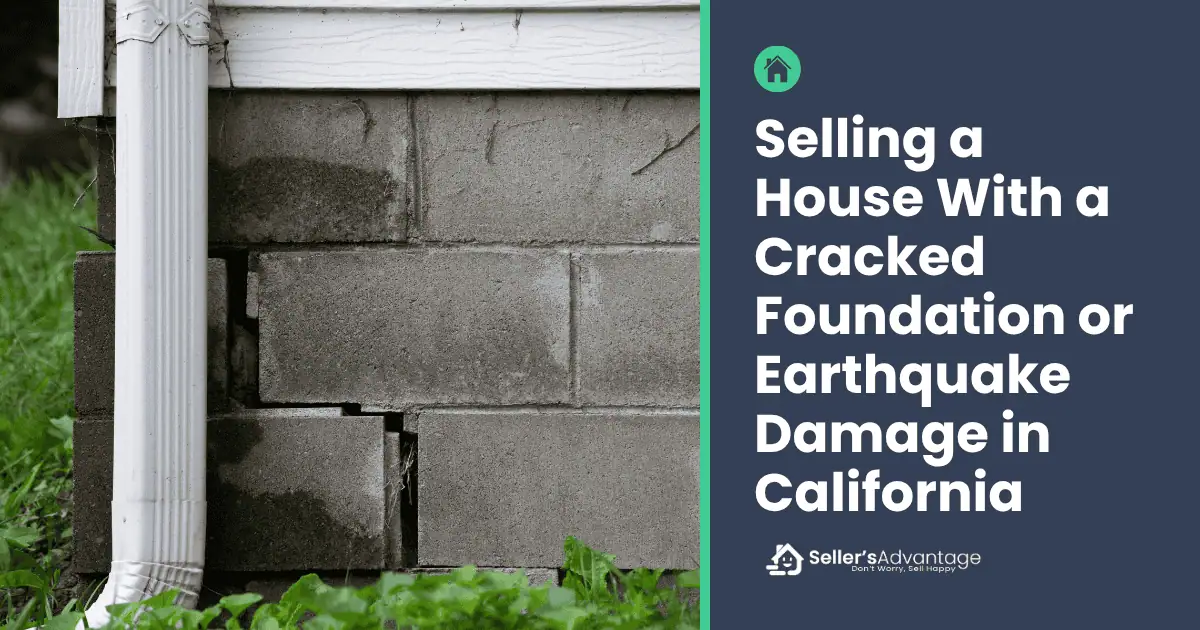
Maybe you noticed a new crack after the last earthquake, or a bedroom door that used to close easily now sticks. Foundation problems are scary because they live under the house, where you can’t see what the damage really is.
None of this means you neglected your home. In Southern California, the ground moves. Older homes have ridden out decades of quakes, and many neighborhoods sit on hillsides or soil that shifts with the seasons. Plenty of California homeowners end up with foundation issues for reasons no owner controls.
You can still sell a house with foundation problems in California, and you have more than one way to do it. The right path comes down to the numbers and how much work you want to take on.
We’re Seller’s Advantage, a family-owned, licensed California brokerage and direct home buyer. Over the years we’ve bought houses all over Southern California, cracked slabs and quake damage included. If repairing first or listing with an agent would leave you with more money, we’ll tell you that.

Why Foundations Crack in Southern California
A foundation is the concrete base that carries the weight of the house. When the ground under it shifts, the concrete has to move with it, and concrete doesn’t bend well.
Earthquakes are the obvious cause. Many older homes sit on short wood walls between the foundation and the first floor, called cripple walls. FEMA notes that houses built this way can slide off their foundations in a strong quake if they aren’t bolted down and braced.
Soil does slower damage. Clay-heavy soil swells when it gets wet and shrinks when it dries out. Researchers at Missouri S&T rank expansive soils among the leading causes of property damage in the country. A wet winter followed by a long, dry summer works on a slab year after year, and that foundation movement shows up as cracks.
Location matters as well. Hillside homes often lean on retaining walls, the walls that hold back the slope, and any structural movement there can reach the house. The state also maps areas where the ground can fail in a quake, either by sliding or by liquefaction. Liquefaction means wet, loose soil briefly acts like a liquid and stops holding the house up. You can look up your address on the California Geological Survey’s EQ Zapp map.
The bigger question for most sellers is how serious their own foundation cracks really are.
Minor Hairline Cracks or Structural Defects?
Concrete and stucco shrink during normal concrete curing and settle over time. Minor hairline cracks show up in a lot of homes, and a crack alone doesn’t mean the foundation has failed.
Certain patterns deserve a closer look. The Utah Geological Survey flags stair-step or X-shaped cracks, cracks that fan out from the corners of doors and windows, and a bulging foundation wall. Oklahoma State’s extension service lists other signs to check. Watch for doors and windows that stick, sloping floors, and cabinets pulling away from the wall. These are the obvious visual indicators, though some damage stays hidden.
A general home inspector can spot structural concerns. A licensed structural engineer is the person who can tell you what they mean. This is an engineer who studies how a building carries weight. A structural engineer is not a general contractor, and they don’t sell repairs. You can confirm an engineer’s license on the state board’s license lookup page.
During a structural inspection, the engineer looks at the structural components that carry the load and judges their structural adequacy. The structural engineer report then lays out a repair plan. It covers the repair scope and the repair methods, such as pier installation, which adds supports that reach down to firmer soil. The goal is to separate minor issues from signs of major structural failure, so you aren’t guessing either way.
A written engineer’s report is worth having whichever path you choose. Findings from a structural engineer typically reduce the guesswork for buyers, and the report records the structural condition you’ll need to share under California disclosure laws.

What California Law Asks You to Disclose
California sellers must share known material defects, meaning problems that would affect a buyer’s decision or the home’s value. Most sellers do that through a transfer disclosure statement, or TDS. It asks about known foundation defects, settling or soil problems, and major damage from earthquakes. Under Civil Code section 1102, a buyer and seller can’t agree to waive it. Selling as is doesn’t skip it. As is means you sell the home in its current condition without making repairs.
A second form, the Natural Hazard Disclosure, tells buyers whether the home sits in certain mapped zones. Under Civil Code section 1103.2, those include earthquake fault zones and seismic hazard zones for landslides and liquefaction.
Older homes come with one more step. For many one-to-four unit, wood-frame homes built before 1960, Government Code section 8897.1 requires the seller to give the buyer the state’s Homeowner’s Guide to Earthquake Safety. You also fill out a short report on known earthquake weaknesses. The guide says you don’t have to fix those weaknesses before you sell. Water heaters are the exception. State law requires them to be braced, and Health and Safety Code section 19211 has you certify that in writing.
Previous repairs belong in the picture too. Your disclosure package can include the repair history: invoices, permits, documented repair costs, and a structural engineer’s sign off on the completed repair. If the foundation repair company offered a transferable warranty, include that as well.
Full disclosure protects you long after closing. Disclosed foundation issues give buyers a fair starting point. An unresolved structural defect a buyer finds later can turn into a dispute. Some sales, such as certain probate and trust sales, follow different rules, so ask a real estate attorney what applies to you.
Disclosure covers what a buyer learns. Insurance covers who pays for the damage, and the answer often surprises people.
What Earthquake Insurance Does and Doesn’t Cover
A standard homeowners policy in California doesn’t cover earthquake damage. According to the California Department of Insurance, the exception is fire. Your policy must cover a fire caused by or following a quake.
Earthquake coverage is a separate purchase, and your insurer has to offer it in writing every other year. Most of these policies come through the California Earthquake Authority (CEA).
The deductible is the part of the loss you pay before coverage starts. Earthquake deductibles are set as a percentage of the home’s insured value. CEA offers options from 5% to 25%. Older homes on raised foundations that haven’t been verified as retrofitted, or strengthened against quakes, carry a 15% minimum, per the same CDI guide.
Buying a policy after a quake won’t cover damage that already happened. The CDI also warns that claims not reported within one year of the loss can be denied. Keep any past claim paperwork, since buyers will likely ask.
Once you know what’s covered, you can run your numbers on fixing the house versus selling it.
Repair First or Sell As Is?
Start with the engineer’s report. Then get repair estimates from at least two licensed contractors, built on that report. Contractors in California tend to charge more than the national average, so local bids are the numbers worth trusting.
Not every fix weighs the same. Cosmetic repairs, like patching stucco, barely move the math. Major foundation work and other major structural repairs can change it completely.
The repair cost is only part of the bill. Foundation work usually needs permits and inspections, and the house may sit empty while crews work. Your mortgage, property taxes, insurance, and utilities keep coming the whole time. These are called carrying costs. Months of major repairs under the floor is a lot to live with, and it’s okay if that’s more than you want to take on.
From there, compare two numbers:
- Repair and list: the likely sale price after repairs, minus the estimated repair costs, carrying costs, agent commission, and closing costs. A commission is the fee agents charge, usually a share of the sale price. Closing costs are the fees to finish the sale.
- Sell as is: the as-is offer, minus your closing costs.
Financing affects your buyer pool. Conventional loan buyers bring a lender’s appraisal, which is an independent estimate of the home’s value. Most also hire their own inspector. A financed buyer’s lender may hold back on a home with unrepaired structural damage, which can slow or stop lender approval.
That leaves four honest options:
- Repair, then list. This often brings a higher net sale price when the foundation repair is clear-cut and you have the time and cash.
- List as is with an agent. You price for the condition and market to buyers who want a project.
- Sell directly to a cash buyer. The buyer takes on the repair and the risk.
- Keep the home and repair over time. This can work if the house is safe and you aren’t in a hurry.
If the report finds severe structural failure, or the repair bid starts to rival what the house is worth, our guide to selling a teardown in Southern California covers that situation. Foundation damage also tends to travel with water problems. Our article on water, termite, and mold damage explains how those repairs affect a sale.
If options two and three are on your list, it helps to see them side by side.
Listing vs. Selling Direct, Honestly Compared
A traditional sale means listing with an agent on the open market. Homes often spend 90 to 120 days on the market, then another 30 to 60 days in escrow. Escrow is the closing period, when an independent company holds the money and paperwork for both sides.
With a house with foundation issues, conventional buyers often come back after inspection asking for a price reduction or a repair credit. A repair credit is money taken off at closing so the buyer can pay for the fix. If their loan falls through, you start over.
A direct sale means a cash buyer purchases the home with their own funds. There are no contingencies you’d find in a traditional mortgage loan. A contingency is a condition that lets a buyer back out, such as their loan not getting approved. There’s also no listing, no showings, and no repair negotiations.
An as-is sale will come in below the market value of a repaired home. The buyer pays for the fix and adds a risk premium, a cushion for problems no one can see yet. What counts is your net, the money you actually keep. Many sellers find the gap is smaller than expected once they add up repairs, commissions, and months of carrying costs.
If a direct sale sounds like the better fit, this is how it works with us.
Selling Your Home to Seller’s Advantage
It starts with a conversation about the house, your foundation concerns, and your timeline. Then a member of our local team walks through the home in person, with no repairs or cleaning needed first. If you already have an engineer’s report or repair bids, bring them. They help, but they aren’t required.
After we’ve seen the house, a no-obligation cash offer may come your way within 24 hours. No-obligation means you can say no and owe us nothing.
If you accept, you’ll sign a purchase agreement, the contract that sets the price and terms, and you choose the closing date. You could close as early as 7 to 14 days out, or we can stretch the timeline to fit your needs. We won’t rush you out of your home.
We don’t charge a commission. We also cover the escrow fees, title insurance, recording fees, transfer fees, and government fees. You’re responsible for paying off your mortgage, any recorded liens, and any unpaid property taxes. A lien is a legal claim against the property for money owed, such as a contractor’s unpaid bill.
Escrow is an independent company that keeps the money and the closing papers until everything is signed. We send our purchase funds to escrow by wire. Escrow then clears your mortgage and any liens and sends you what remains. You won’t need to wire money to anyone.
Sometimes life can’t wait for closing day. On a cash purchase, up to $20,000 of what you’ll receive can be paid out ahead of time to help you start your next chapter. It’s taken from your proceeds at closing, so it isn’t a loan and there’s no added fee.
Selling as is to us doesn’t change your disclosure duties. You’ll still share what you know about the foundation, and our team will walk you through each form.
FAQ’s About Foundation Problems
Do I have to fix the foundation before I sell? In most cases, you don’t have to repair foundation problems before you sell. You do have to disclose foundation problems you know about. The exception is water heater bracing, which state law requires and you certify in writing.
I patched a crack years ago. Do I still need to mention it? Yes. Share the problem and the repair, along with any receipts or reports. A patch on the surface doesn’t change what the TDS asks about.
Talk It Through Before You Decide
Selling a house with a cracked foundation can feel overwhelming, but you don’t have to face it alone. At Seller’s Advantage, we’re here to guide you every step of the way, moving at a pace that feels right for you. We’ll help you get the facts, run the numbers, and figure out the best path forward, whether that’s repairing first or selling as-is. Whatever you decide, we’ll be honest and supportive.
Talk with our team about your house →
Sell Your House Fast For Cash
We Buy Houses in Southern California As-Is
Close on your timeline and avoid the hassle of traditional fees.

Get My Free,
No-Obligation Quote
Call us today at 800-208-3243 and get an offer in as little as 24 hours. It’s quick and easy!
"*" indicates required fields
Southern California’s Most Trusted Home Buyers

