
Owning a small rental was supposed to be simpler than this. Then the water heater goes out on a Sunday night. A tenant falls behind. The insurance renewal arrives higher than last year, and the rent stops feeling like income. Wanting out of that does not make you a bad landlord. It usually means the work grew past what you signed up for.
We’re Seller’s Advantage, a family-run Southern California brokerage. We buy homes directly, and we are licensed to list them as well. Selling a duplex is a different job than selling a house, mostly because two households come attached to it, and California puts firm rules around both, even when you work with a cash home buyer in California.
If a traditional listing would put more money in your pocket, we will tell you that. What follows is general information, not legal or tax advice. The rules in Los Angeles are not the rules in Riverside, so a California real estate attorney and a CPA are the right people to check your specifics.
Why a Duplex Doesn’t Sell Like a House
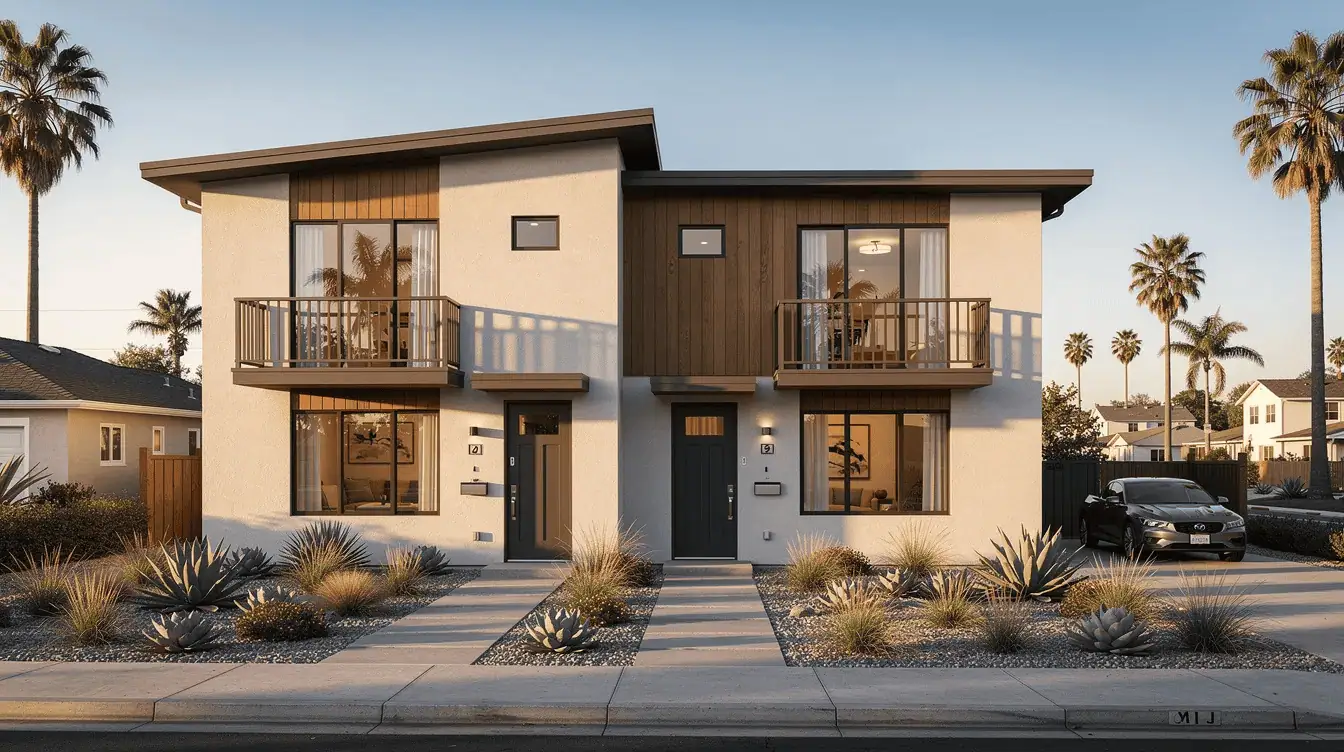
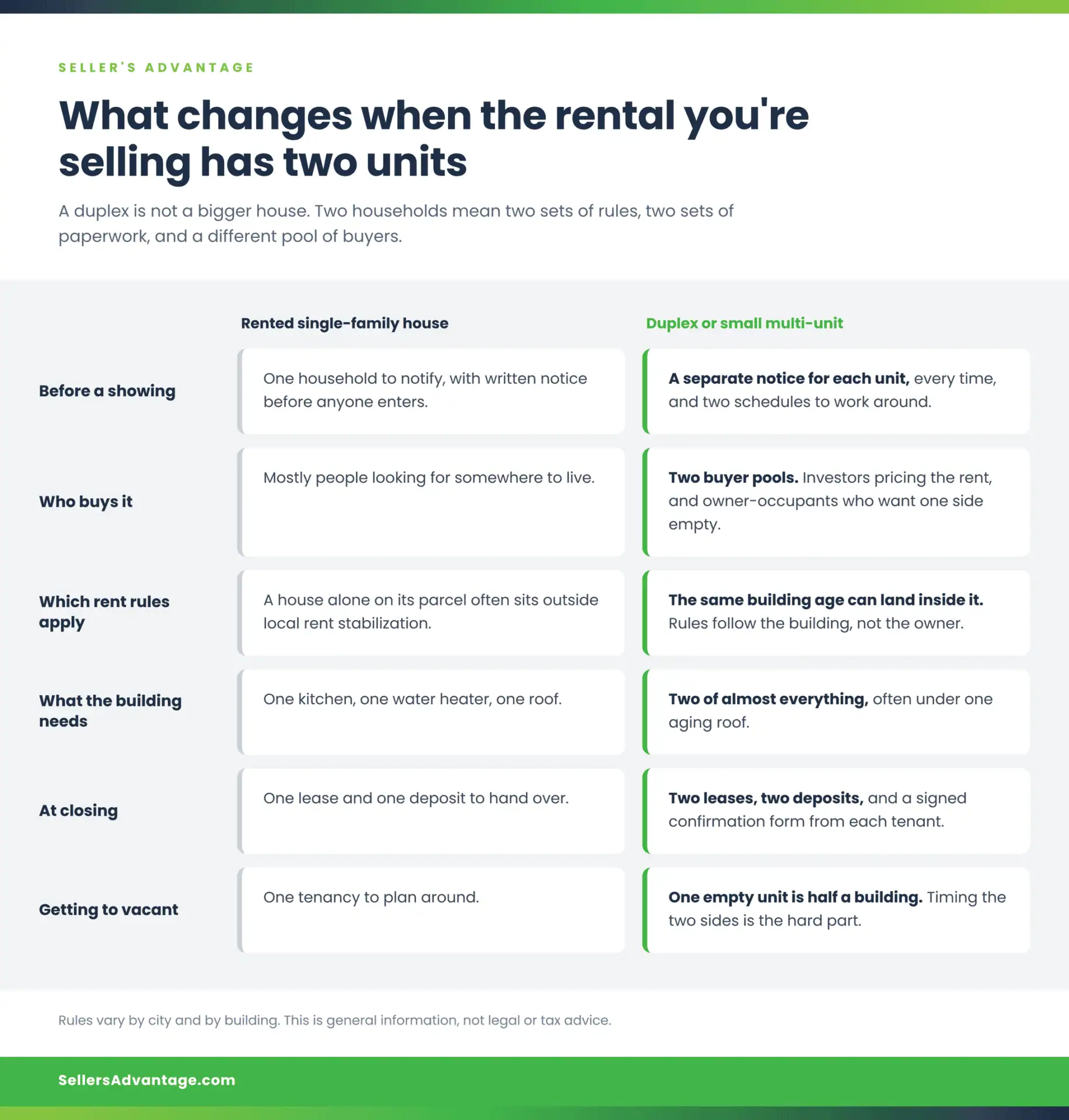
A house listing sells a place to live. A duplex sells a place to live and a small business at the same time, and buyers price both.
That splits your buyer pool. Investors look at rent, condition, and what the units could earn. Owner-occupant buyers look at whether they can live on one side and rent the other. Buildings with two to four units still qualify for ordinary home loans in most cases, so that second group is real. Most of them want one unit empty on move-in day.
Condition carries more weight here too. A duplex has two of almost everything: two kitchens, two water heaters, often one aging roof over both. That wear is not neglect on your part. It is what happens when rent covers the mortgage and leaves little room for a new roof.
The paperwork doubles as well. Two tenancies mean two notices, two sets of records, and two schedules to work around before anyone can see the property. Which rules apply to those tenancies depends on something you may not have checked in years.
The Rules Follow the Building, Not the Owner
Duplex owners get stuck here more than anywhere else, because a rented house and a rented duplex often live under different laws on the same street.
In the City of Los Angeles, the Rent Stabilization Ordinance generally covers rental property first built on or before October 1, 1978. The Housing Department lists duplexes as covered property types, while a single-family home alone on its parcel is generally not covered. Covered buildings come with limits on rent increases, a required legal reason for ending a tenancy, and relocation payments in some no-fault situations, meaning the tenant did nothing wrong. If your building is newer, the city’s Just Cause Ordinance may still apply.
Statewide, the Tenant Protection Act adds just cause protection once a tenant has lived in the unit about a year. Just cause means a reason the law actually lists, such as unpaid rent or an owner moving in. Deciding to sell is not on that list, and a sale by itself does not end anyone’s tenancy.
There is one exemption built for owners like you. Under state law, a duplex where the owner lives in one unit as a principal residence can sit outside those state rules. The exemption leans on your continued occupancy, so it can end when you move out. Local ordinances can also apply on top of it. Before you rely on being exempt, have an attorney confirm it in writing.
Once you know which rules cover the building, the next question is how to show it without making life miserable for the people inside.
Showing the Property Without Wearing Out Your Tenants
Your tenants did not ask for this sale. Treating them with care is the decent move, and it also protects the sale. A frustrated tenant can make a property nearly impossible to show.
California sets the floor. Civil Code 1954 treats 24 hours as reasonable notice before entering an occupied unit to show it. Notice goes to each unit on its own, so a duplex means two notices every time. Entry belongs in normal business hours unless the tenant agrees otherwise, and these rules still apply when you’re selling a California property as-is.
The statute also holds a shortcut worth knowing. Once you give a tenant written notice that the property is for sale, you can use spoken 24-hour notice for showings for the next 120 days. That 120 days is not a waiting period, which is a common misreading. It is the window your written notice stays good for.
Notice rules govern the months before closing. A separate set of rules governs what actually changes hands on closing day.
What Transfers to the Buyer and What Doesn’t
Leases go with the building. A buyer steps into your position and inherits the rent amount, the end date, and the rest of the terms. Our guide to selling a tenanted property walks through that handoff in more detail.
Security deposits move too. Deposit money belongs to the tenant, so at closing it either transfers to the new owner or goes back to the tenant. Either way it gets accounted for in writing. Owners who spent a deposit years ago on a repair find this out at the worst possible moment, so check your records early and be just as cautious about cash buyer scams and rip-offs.
Expect a request for an estoppel certificate from each tenant. That is a short form the tenant signs confirming the rent, the deposit, the lease dates, and any side agreements. Buyers use it to confirm the paperwork matches the tenancy. Give tenants a week to sign, not a day.
Rent gets prorated at closing, along with property taxes, meaning it is split between you and the buyer by date. If a tenant paid the last month up front, that money follows the tenancy to the buyer.
That covers the property. The other transfer worth planning for happens on your tax return, especially if you’re trying to sell a house that’s already listed on the market in California.
The Tax Bill Most Duplex Owners Forget
This part catches good record keepers off guard, and it is easier to face months before a sale than in April.
Every year you rented the unit, you were allowed to deduct depreciation, which is a yearly write-off for the wear on the building. When you sell, the IRS takes that benefit back through depreciation recapture. IRS guidance puts a maximum rate of 25% on that portion of the gain. Gain above the recapture amount is taxed at long-term capital gains rates instead.
The trap sits in the wording. Recapture applies to the depreciation you could have claimed, not only what you did claim. Owners who never took the deduction still owe it. California also taxes the gain, so both bills should be part of the same conversation with a CPA.
Two other paths are worth raising with that CPA. A 1031 exchange lets you roll the proceeds into another investment property and defer the tax, though the deadlines are short and unforgiving. And if you lived in one of the units, part of the gain may be treated as the sale of your home rather than an investment, which is a separate calculation.
Knowing the tax picture changes how the options below compare, so run those numbers before you pick a path.
Your Real Options, Compared Honestly
Four paths make sense for most small multi-unit owners, and the best one depends on your timeline, the building’s condition, and how much management you have left in you, whether you’re leaning toward a traditional sale or a cash for houses option in Los Angeles.
Keep it. If the units are full and the mortgage is comfortable, holding costs you nothing but the management. A property manager takes most of that workload and a slice of the rent. This is the path to measure the others against.
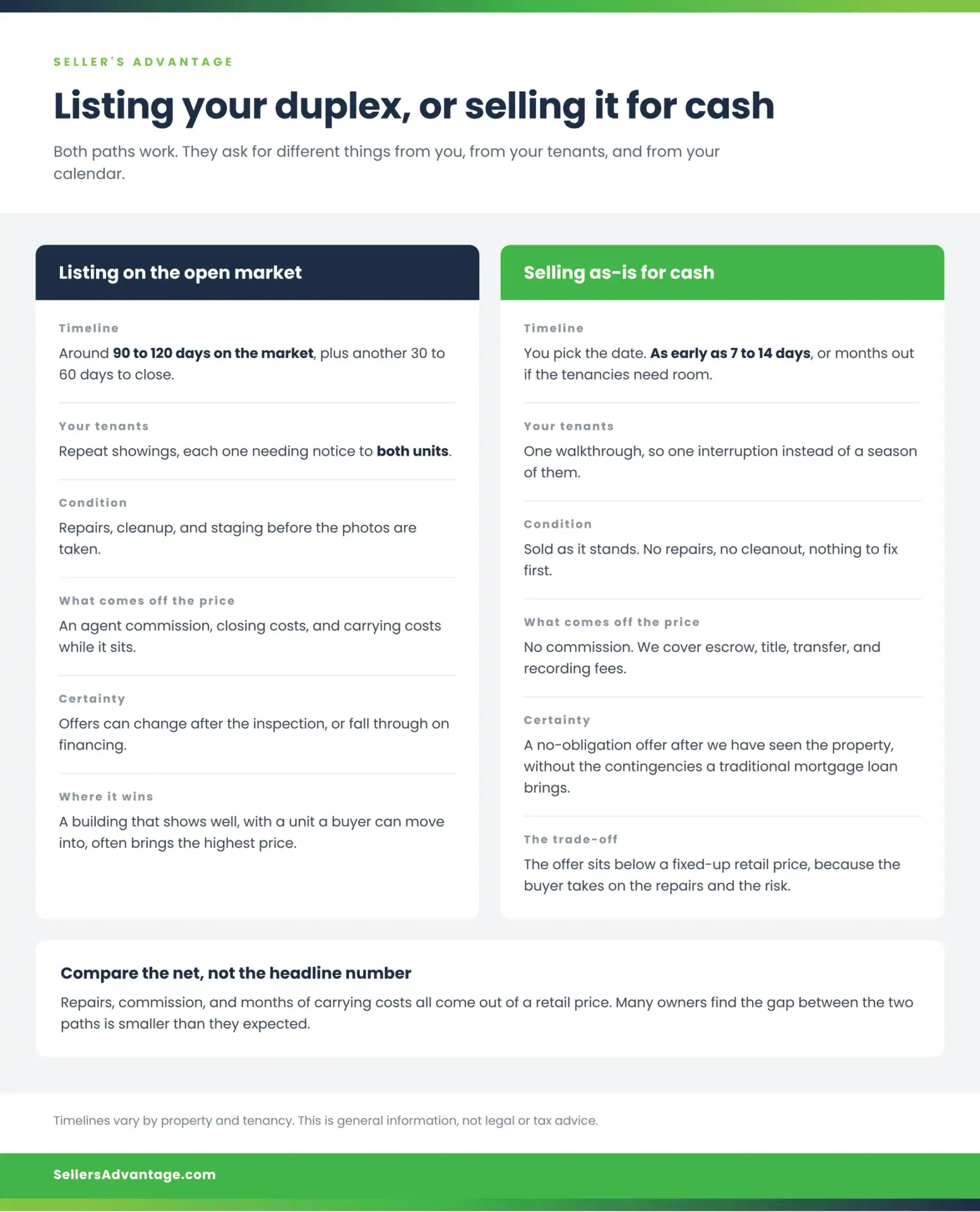
Sell it rented on the open market. Investors buy occupied buildings all the time, because the rent starts on day one. You keep collecting rent right up to closing. Plan on 90 to 120 days on the market, plus another 30 to 60 days to close. Add an agent commission, showings coordinated around two tenancies, and repair requests after the inspection, along with the usual challenges of selling a home as-is.
Wait for a unit to open, then list. A vacant unit widens your buyer pool to owner-occupants, who often pay more than an investor will. Waiting means carrying an empty unit, and rushing a tenant out is where owners find legal trouble.
Sell as-is to a direct buyer. As-is means the building sells in its current condition, with no repairs and no cleanup expected from you. There is no listing period, no staging, and no commission. The offer sits below what a fixed-up retail sale might bring, because the buyer takes on the repairs and the risk. What matters is the net, and the gap between the two numbers is usually smaller than owners expect once repairs, commission, and months of carrying costs come out of the retail price when you work with a local cash home-buying company.
If that last path sounds like the right fit, and you like the idea of selling your house for cash in as little as 7 days, the mechanics are worth walking through.
How California Cash Buyers Work With Units Involved
Selling to us starts with a conversation about the building, the tenancies, and what you need out of this. Someone from our team then walks the property, including both units where access allows. Once we have seen it in person, you may have a no-obligation cash offer within a day, with all the usual benefits of selling to a cash investor. The offer reflects condition, location, and what the Southern California market is doing right now, which you can see in our Southern California housing market analysis.
Timing then follows you. You pick the closing date. That can be as early as 7 to 14 days. It can also sit months out if you need to work around a lease or your own move, or even sell California real estate after you move away. We will not rush you out of your building.
Escrow handles the money. Escrow is a neutral third party that sits between you and the buyer, holding the documents and the funds until every condition is satisfied. The purchase money is wired into escrow rather than to you. From there, escrow clears your mortgage and any liens, meaning legal claims recorded against the property, such as unpaid taxes or a contractor’s bill. Whatever remains is sent to you. You never wire anything yourself when you sell to a reputable cash home buyer in Southern California.
We don’t charge a commission, and we cover the government fees, transfer fees, recording fees, escrow fees, and title insurance. You stay responsible for your mortgage payoff, any recorded liens, and unpaid property taxes, just as you would with any of the top Los Angeles home buying companies.
Money sometimes needs to move before closing day. If that is where you are, ask about our cash advance. On a cash purchase, up to $20,000 of what you are already owed can reach you early, to help you start your next chapter. That amount comes out of your proceeds at closing. It is not a loan, and there is no fee attached.
Most of the questions we hear from duplex owners land in the same few places.
Questions Duplex Owners Ask
Can I sell if only one unit is rented? Yes. A partly occupied duplex sells regularly. The rented side follows the tenant rules above, and the empty side does not.
Do I have to tell my tenants I’m selling? You have to give proper notice before anyone enters to look at a unit. Beyond that legal minimum, telling tenants early goes better than letting them work it out when a stranger arrives with a clipboard. Tenants who feel respected cooperate.
Will I owe tax if I never claimed depreciation? Probably. Recapture is based on the depreciation that was available to you, whether or not you took it. A CPA can tell you what that looks like on your return.
Can you buy my duplex with tenants still living there? Our purchases work around the lease rather than taking it over, so the timing depends on where your tenancies stand. That is the first thing to talk through, and it is a straight yes or no answer, not a negotiation.
Talk It Through Before You Decide Anything
You don’t need to have all your paperwork perfectly organized or your mind completely made up to start chatting about selling your duplex. Many owners reach out while they’re still figuring out if selling is even the right step. We’re here to help guide you through every part of that conversation.
If a cash sale turns out to be the better option, we’ll walk you through the numbers clearly. And if listing your duplex would bring you more, we’ll be upfront about that too, and happy to talk about how to make that happen.
Talk with our local team about your duplex →
Sell Your House Fast For Cash
We Buy Houses in Southern California As-Is
Close on your timeline and avoid the hassle of traditional fees.
Get My Free,
No-Obligation Quote
Call us today at 800-208-3243 and get an offer in as little as 24 hours. It’s quick and easy!
"*" indicates required fields
Southern California’s Most Trusted Home Buyers

