

Home insurance in California has gotten harder for nearly everyone. Premiums climb, carriers pull out of neighborhoods they wrote in for decades, and a lot of homeowners are opening mail they never expected to get.
If that’s where you are, it says nothing about how you’ve kept up the house. Insurers are repricing by ZIP code, not by homeowner. The foothills of Los Angeles County, the canyons of Orange County, and the brush edges of Riverside and San Bernardino are all getting versions of the same letter.
We’re Seller’s Advantage. We’re a family-owned team in Southern California, and we buy homes directly from owners too. Insurance comes up in more of those conversations every year, and it usually arrives as the same question: does this mean I have to sell? Not necessarily. Selling is one answer to an insurance problem, and it’s rarely the first one worth reaching for.

Your Insurance Company Owes You 75 Days
That letter tends to land like a countdown. More time is built into it than it looks. The first thing to sort out is which kind of letter you actually got, because two different things get called the same thing.
A non-renewal means the insurer won’t continue your policy past the end of its current term. Under California Insurance Code section 678, the company has to deliver or mail written notice at least 75 days before the policy expires, stating the specific reason. Miss that window and your existing policy stays in force for 75 days from the date the notice went out. The notice also has to point you to the Department of Insurance’s Home Insurance Finder, a search tool for companies still writing in your area.
A cancellation happens mid-term and is limited to narrower grounds, such as nonpayment. If your letter says non-renewal, you have a runway. Use all of it.
One more protection is worth checking, and plenty of homeowners never hear about it. When the Governor declares a wildfire emergency, Insurance Code section 675.1 bars insurers from cancelling or non-renewing residential policies in the affected ZIP codes for one year from the declaration date. The Department publishes the covered ZIP codes for every fire. Three things get missed. The protection reaches ZIP codes adjacent to the perimeter, not just inside it. Bulletins can cover cancellations issued up to 90 days before the declaration. And a total loss earns up to 24 months rather than 12.
Why California Repriced Your ZIP Code
The January 2025 firestorms in Los Angeles County changed the arithmetic for every carrier writing in Southern California, and the effects are still moving through the market.
The California FAIR Plan is the state’s insurer of last resort, a pool funded by the licensed insurers doing business here. It sells basic fire coverage to owners who can’t find a policy on the open market, and it was built as a temporary landing spot. It has not behaved like one. Policy counts roughly doubled as carriers declined both new business and renewals.
That growth costs money. The Department of Insurance approved a FAIR Plan dwelling rate increase averaging 29.1% on new and renewal business starting October 15, 2026, concentrated in the wildfire portion of the premium. Properties at significant wildfire risk will land well above that average. Some lower-risk policyholders will actually see a decrease.
Worth knowing: FAIR Plan growth is finally slowing. New business dropped sharply in early 2026. The Department’s Sustainable Insurance Strategy lets carriers price wildfire risk using forward-looking models and pass along reinsurance costs. In exchange, they have to write a set share of their business inside ZIP codes the Department flags as underserved. Short term, higher premiums in fire-exposed areas. Longer term, more companies back in the market for your address.
Which is why the first move is not selling. It’s shopping.
Four Moves to Make Before You Think About Selling
Re-shop through an independent broker, meaning one who works with many carriers rather than a single company. Carriers that stopped writing in your area two years ago are filing to come back, and availability changes by the quarter. Ask who is quoting your ZIP code this month.
Check the moratorium list. If your property sits within or next to a recent fire perimeter, the one-year protection may already cover you.
Document the work you’ve already done. Insurers that price wildfire risk have to discount qualifying mitigation under the state’s Safer from Wildfires rules: clearing the five feet closest to the structure, ember-resistant vents, fire-rated roofing. Your insurer also has to give you your property’s wildfire risk score and explain how to lower it. Photos and receipts turn completed work into a lower bill.
Treat the FAIR Plan as a bridge. Its dwelling policy covers basic fire perils only. Most owners add a Difference in Conditions policy, a supplement that fills the liability, theft, and water damage gaps the FAIR Plan leaves open.
If you’ve worked all four and the number still doesn’t fit your life, that’s real information. It isn’t a failure on your part.
Going Without Coverage Costs More Than Coverage
Some owners quietly let the policy go. That option is worse than it looks.
If your home carries a mortgage, the loan requires hazard insurance. When yours lapses, the servicer can buy a policy and bill you for it. That’s force-placed insurance. It generally protects the lender’s interest rather than yours, and it can cost about twice what you’d pay for a policy you shopped yourself. Your servicer has to warn you at least 45 days before charging you, then send a reminder at least 15 days out. Use that window.
So the choice is rarely between an expensive policy and nothing. It’s between an expensive policy and a costlier one that covers less, with an uninsured total loss underneath both.
Once you’ve priced it honestly, selling stops being an emotional decision and becomes a math decision.
When Selling Becomes the Reasonable Answer
No single trigger decides this. The pattern we see most is a gap that won’t close. The premium has moved past what the household income can carry, and the work that would lower it costs more than there is to spend.
A home with deferred repairs an underwriter flags can get stuck, priced as high-risk precisely because the repairs that would lower the risk aren’t in the budget. If the property has open wildfire damage, sort out how any active claim will be handled before you start a sale.
Any of those can make selling the calmer path. What surprises most owners is what happens next.
The Problem a Financed Buyer Brings With Them
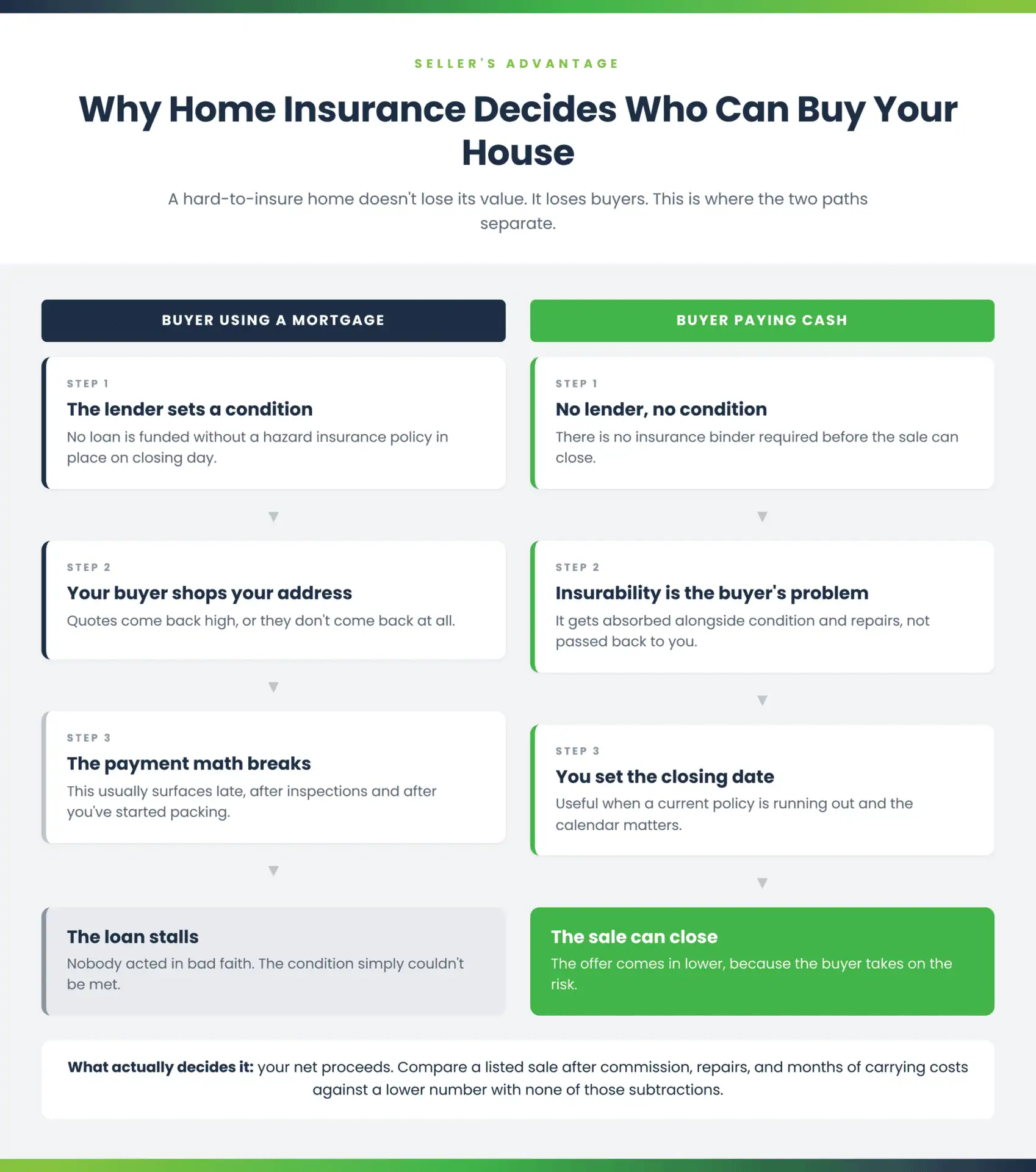
Most buyers borrow, and a lender won’t fund the loan without a hazard insurance policy in place at closing. Your buyer has to insure your house before they can buy it.
If quotes on your address come back sky-high, or don’t come back at all, the loan stalls. It happens late, after inspections, after you’ve cleared out half the garage, when the buyer’s quote lands and their payment math falls apart.
Disclosure matters here too. California sellers have to disclose known material facts about the property, and any insurer a buyer approaches pulls a claims history on the address, so a non-renewal doesn’t stay quiet. Homes in mapped fire hazard zones carry extra disclosure duties on top of that. Ask a real estate attorney which ones reach your property. Either way, holding it back costs you the buyer later instead of earlier.
A buyer paying cash has no lender demanding proof of coverage. That’s the structural difference, and it’s why an insurance problem often pushes an ordinary house toward an off-market sale.
Listing It vs. Selling It As-Is
Listing on the open market still produces the highest gross price when the house shows well and a buyer can actually get it covered. It also takes time. Selling your house when it’s already listed on the market can involve 90 to 120 days of market exposure in Southern California, followed by an additional 30 to 60 days in escrow.That’s the stretch where an outside company holds the funds and the paperwork until both sides have met every condition. You’re paying the premium across all of it. Keep coverage in force through the closing date, because until the transfer is recorded the risk is still yours. There’s also a commission, plus whatever repairs come out of the buyer’s inspection.
Selling as-is means no repairs, no staging, and no strangers walking through on weekends. A cash offer comes in under what a fixed-up house would fetch on the open market, because the buyer absorbs the repairs and the risk. If you’re planning to sell your home as-is, what decides it is net proceeds: what lands in your account after commission, repairs, and months of carrying costs, against a lower number with none of those subtractions. Many sellers find the gap is narrower than they assumed.
Neither one is automatically right. Run both numbers before you commit to either.
What Selling to Us Looks Like
If the cash route is the one that fits, selling your house today to cash investors follows a simple shape.
Someone local comes out and walks the property. After that visit, you may have a no-obligation cash offer in hand within 24 hours. You don’t clean anything out first and you don’t fix anything first. Turn the offer down and nothing happens.
You pick the closing date. We can buy your house in as little as 7 days, and a cash sale can reach closing as early as 7 to 14 days. If that’s quicker than suits you, the date moves out as far as you need it to, and nobody here will push you to leave sooner. We don’t charge a commission, and we cover the government fees, transfer fees, recording fees, escrow fees, and title insurance. Your mortgage, any recorded liens, and unpaid property taxes stay your responsibility, and all of them come out of proceeds at closing rather than out of pocket.
Your buyer’s funds land with the escrow company first. Your mortgage, any liens, and back taxes get settled out of that account, and the balance is sent to you. Wiring money is not something you’ll be asked to do at any stage.
One option, only if you need it: when waiting for closing day would put you in a bind, ask what we can release early. On a cash purchase we can put up to $20,000 in your hands before the closing date, drawn against the proceeds you’re already owed at closing. It isn’t a loan and it isn’t an added fee. It’s there to help you start your next chapter.
Questions We Get About Insurance and Selling
Can I sell a house that has no insurance on it right now? Yes. A lapse doesn’t block a sale. It does narrow your buyer pool toward cash, since a financed buyer’s lender requires coverage before funding.
Do I have to tell buyers my policy was non-renewed? Ask a real estate attorney how the disclosure rules apply to your situation. Plan on the information surfacing either way, since any insurer a buyer approaches pulls the claims history on the address.
What happens to coverage if the house sits empty while it’s listed? Vacancy changes how insurers treat a property, and some policies limit or exclude coverage on a home nobody lives in. Tell your broker before it goes empty, not after.
Do I get money back for the coverage I don’t use? Ask your insurer. Unused premium is often refundable once the policy ends at closing, and it’s an easy thing to leave on the table.
Will the offer be lower because the house is hard to insure? Insurability is one of the things a cash buyer absorbs, along with condition and repairs. Whether that’s the right trade depends on what a listed sale would net you.
Can you close before my current policy lapses? Often, yes. Bring us the expiration date early and we’ll work backward from it. If the timing doesn’t line up, we’ll say so rather than promise otherwise.
Talk It Through Before You Decide
An insurance letter can make a decision feel urgent when it isn’t. You have 75 days at minimum, and possibly a full year if your ZIP code sits inside a wildfire moratorium. That’s time enough to re-shop, document your mitigation work, and price the alternatives.
If you’ve done that and selling is where the numbers land, we’ll walk through what a cash sale would net you and how it compares to listing. If listing is the better move, we’ll tell you that too, and we won’t chase you afterward.
Talk with our local team about your home and your insurance situation →
Sell Your House Fast For Cash
We Buy Houses in Southern California As-Is
Close on your timeline and avoid the hassle of traditional fees.
Get My Free,
No-Obligation Quote
Call us today at 800-208-3243 and get an offer in as little as 24 hours. It’s quick and easy!
"*" indicates required fields
Southern California’s Most Trusted Home Buyers

