
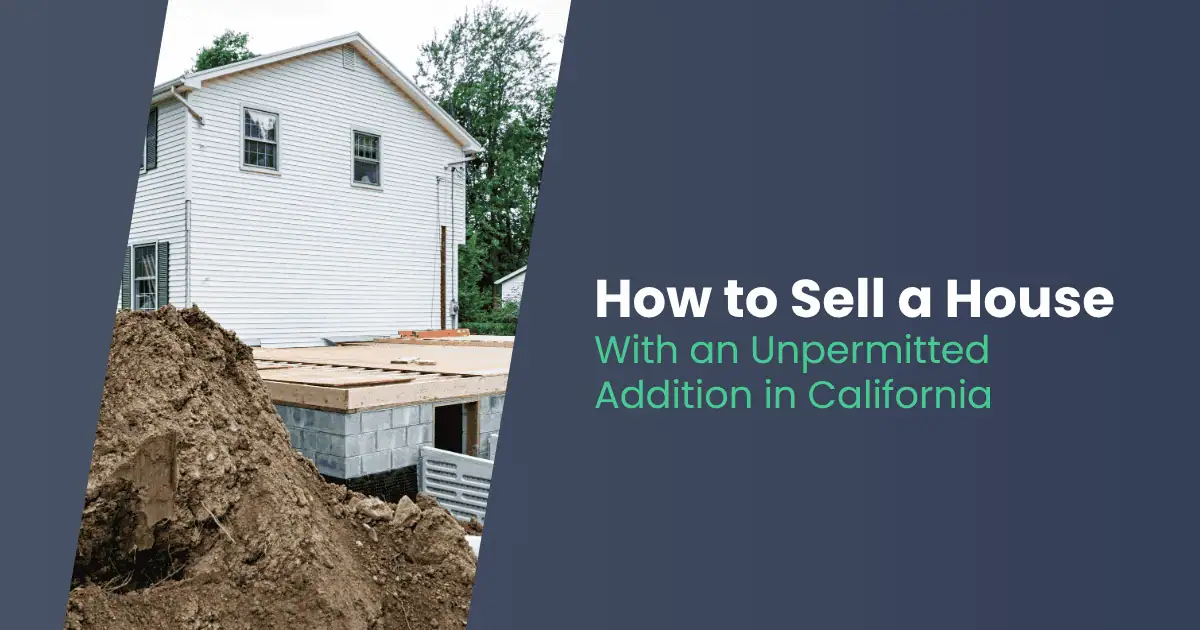
A lot of Southern California homes have a converted garage, an enclosed patio, or a backyard unit that never got a permit. Sometimes the current owner built it, but more often it came with the house, and nobody said a word until an appraiser asked for paperwork that does not exist.
Finding out feels worse than it usually turns out to be. Work done without permits is common here, it can be disclosed, and the house can still sell. What changes is who can buy it and how long the sale takes, not whether a sale is possible.
We’re Seller’s Advantage, a family-run, licensed California brokerage that buys homes directly across Los Angeles, Orange, Riverside, San Bernardino, and San Diego counties. Permits are a local matter, so the answer in Riverside often looks nothing like the answer in Long Beach. Each city runs its own building department and decides how hard to push on old work.
Two real paths lead out of this. You can legalize the work before you sell, or sell the property as it stands. If legalizing first would put more money in your pocket, we will let you know.
What the City Actually Counts as Unpermitted
Unpermitted work means the city never approved it and never inspected it, so no final sign-off sits in the building department’s file for that address. The work may be well built and perfectly safe, but without that sign-off the city treats the space as though it is not there.
An accessory dwelling unit, or ADU, is a second self-contained home on the same lot as the main house, with its own kitchen, bathroom, and place to sleep. A junior accessory dwelling unit, or JADU, is a smaller version carved out of the existing house, usually 500 square feet or less. A room addition is different again, because it expands the main house rather than creating a separate home.
That distinction matters, because the state law covered below applies to ADUs and JADUs and not to a bedroom added onto the main house.
A permit that was pulled but never finaled is a different problem from no permit at all. The city already knows the work happened and is waiting on an inspection that never came. Those tend to be easier to close out.
This region ended up with so much of it for reasons that are not hard to follow. Much of the housing stock went up between the 1950s and the 1970s. Rents climbed, families grew, and permitting stayed slow. A garage became a bedroom on a Saturday, and forty years went by.
You Disclose It Either Way, Even Selling As-Is
Selling as-is means selling the property in its current condition, with no repairs made before closing. It does not mean selling without telling the buyer what you know.
California requires most residential sellers to complete a Transfer Disclosure Statement, the standard form set by Civil Code Section 1102 and the sections that follow it. Two separate lines on that form ask about additions, structural changes, and repairs made without the necessary permits, and about work that does not meet building codes. They are asked separately because a permit problem and a code problem are different things.
Selling as-is does not remove this. The Legislature wrote directly into that same article that a transfer disclosure statement cannot be waived in an as-is sale.
The standard is what you know. You disclose the work you are aware of, and you are not expected to report what you genuinely never knew. If you inherited the house or bought it with the addition already there, say exactly that on the form.
Pulling the property’s permit history from your city or county building department is worth the trip, because the file will show you what the buyer’s appraiser is going to find. Owners dealing with a broader mix of citations and enforcement issues, not just permits, will find more in our guide to selling a house with code violations.
Once you know what is on record, the next question is whether the state will let you fix it.
The Law That Reopened Older Backyard Units
California opened a legalization path for older accessory units through AB 2533, which took effect January 1, 2025. Under it, a city cannot deny a permit to legalize an ADU or JADU built before January 1, 2020 simply because the unit breaks building standards or does not match the local ADU ordinance.
The protections are specific. Cities have to publish a checklist of the conditions that make a building substandard. Before applying, you may hire a licensed contractor for a confidential third-party code inspection, so you can see the scope privately first. In most cases the city cannot charge impact fees or utility connection charges. When an inspector finds health and safety problems, the city is directed to approve the permits needed to correct them rather than penalize you for the unit existing.
The limits are just as specific. A city can still deny the permit if fixing the violation is necessary to meet the state’s substandard housing standards, and the law does not apply to a building already deemed substandard. It covers accessory units, not room additions on the main house. Coastal zone and historic properties carry approvals of their own on top of this.
Current details, including the section numbers, live in the state’s ADU Handbook from the Department of Housing and Community Development, which HCD updates as the law shifts. The Government Code section carrying these protections was renumbered in March 2024, so older articles citing the previous number are pointing at a section that has moved.
Legalizing solves the permit question. It does not by itself solve what a lender will do with the space.
What It Does to Your Buyer’s Loan
Most buyers need financing, and financing runs on an appraisal. Under Fannie Mae’s appraisal rules, an appraiser who spots an addition without the required permit has to comment on the quality of the work and what it does to the property’s market value.
Accessory units get handled differently again. An ADU’s living area is reported on its own line rather than folded into the main house’s above-grade square footage. A 1,200 square foot house with a 400 square foot converted garage out back does not appraise as a 1,600 square foot house.
Even a unit that zoning does not allow can still work for a conventional loan, though the conditions are strict. The appraisal has to show the property is typical for the market using at least two comparable sales with the same non-compliant zoning use, and the lender has to confirm the unit will not jeopardize a future insurance claim.
Meeting all of that takes comparable sales that exist and a lender willing to work the file. Plenty of buyers and loan officers pass rather than try. That is the real cost of unpermitted space, a smaller pool of buyers who can close.
Worth a call of your own: ask your insurance carrier how the unit is treated under your current policy. That answer affects both you and whoever buys next.
Legalize First, or Sell It As It Stands
Both routes work, and the right one depends on the unit and on what you need from the sale.
Legalizing gives you official square footage, a wider set of qualified buyers, and an appraisal that counts the space. You will need plans, inspections, and time, and inspectors sometimes need walls opened to see what is behind them. Cost tracks the scope of the work, which is why that inspection is worth so much before you commit. It turns a worry into a list.
Selling as it stands trades that work for speed. A traditional listing runs roughly 45 to 90 days total from listing to close, and legalizing first means that clock starts after the permit work finishes. Selling as-is hands the question to a buyer who does this for a living.
A cash offer on a house with unpermitted space comes in below retail, because the buyer takes on the permit work, the inspections, and the risk that the city asks for more than expected. What matters is your net, after repairs, commission, carrying costs, and the legalization work itself. Sellers are often surprised how much smaller the gap gets once all of it lands in one column.
Legalizing tends to pay off when the unit predates 2020, appears sound, and the city’s checklist comes back short. Selling as-is tends to make more sense when an enforcement case is open, when the work needs structural repair, or when your timeline is set by something other than the house.
Questions We Get From Owners of Unpermitted Space
The city already sent me a notice. Can I still sell? Yes. You disclose the notice, and any recorded fines get cleared at closing rather than out of your pocket beforehand. A lien is a legal claim recorded against your property for an unpaid debt, and liens are settled through escrow. Escrow is the neutral third party that holds the money and the paperwork until a sale is final. Your buyer sends the purchase funds there, escrow clears the mortgage, recorded liens, and unpaid property taxes, and what remains comes to you. You never send money out of your own account.
Do I have to tear it out? Demolition is one option, not the default one. For accessory units built before 2020, state law now pushes cities toward permitting and correcting rather than removing.
Will the buyer’s lender find out? Assume yes. The appraiser walks the property, and permit history is public record.
Someone is living in the unpermitted unit. Does that change things? It changes a great deal. California tenant protections apply regardless of permit status, and the rules on notice, relocation, and just cause are strict. Talk with an attorney before you put anything in writing to a tenant.
If I legalize, will my property taxes go up? Possibly, since permitted improvements can be assessed. Ask your county assessor’s office and a CPA how it would apply to your property, because we don’t give tax advice.
Does the buyer’s title insurance cover unpermitted work? Generally no. Title insurance covers ownership and recorded claims against the property, not whether construction met code.
Talk to Us Before You Spend Money on Permits
Owning a house with a permit problem is a quiet kind of stress. It sits there for years, then moves to the front of your mind the week you decide to sell. We’ve spent years buying houses across Southern California, plenty with converted garages and backyard units no file ever recorded.
We buy in any condition, and we don’t charge a commission. We make an offer only after someone from our team has come to your home and walked through it in person. Once we’ve seen everything, you may have a no-obligation cash offer within 24 hours, even if you only want a real number to consider and compare. If you decide to move forward, you pick the closing date. Some sellers close as early as 7 to 14 days, and others need months to sort out a tenant or line up their next place. We won’t rush you.
If cash is tight before the sale wraps, ask about an advance. On a cash purchase we can release up to $20,000 of your own proceeds early, applied against what you receive at closing. It is not a loan and it is not an added fee. It is there to help you start your next chapter.
If a licensed contractor tells you that legalizing the addition is straightforward and the numbers favor doing that work first, we’ll tell you to go do it and call us later if you still want to sell. Whatever you decide, you shouldn’t have to figure the permit question out by yourself.
Sell Your House Fast For Cash
We Buy Houses in Southern California As-Is
Close on your timeline and avoid the hassle of traditional fees.
Get My Free,
No-Obligation Quote
Call us today at 800-208-3243 and get an offer in as little as 24 hours. It’s quick and easy!
"*" indicates required fields
Southern California’s Most Trusted Home Buyers

