
Maybe you opened a home equity line to redo the kitchen, cover college costs, or get through a hard year. Now you’re ready to sell your house, and there’s a second loan sitting behind the first one. Many homeowners stop right there and wonder what happens to a HELOC when the house sells.
In most sales, it gets paid off from the sale proceeds on closing day, along with your primary mortgage. You don’t have to pay anything off ahead of time. Southern California’s high home values give many owners plenty to borrow against, so second loans are common here.
We’re Seller’s Advantage, a family-owned Southern California company. We’re a licensed brokerage, and we also buy homes directly. Over the years we’ve bought houses all over the region, many of them with more than one loan attached. The steps to pay off a HELOC when selling a house are the same whether you list the home or sell it to us. If listing is the better move for your numbers, we’ll say so.
The first thing to sort out is which kind of second loan you have.
Two Loans on One House
When you bought the home, your mortgage lender paid the seller and, in return, recorded a legal claim against the house. That claim is called a lien. It’s a public record of the lender’s right to be repaid from the house.
Your equity is the part of the home’s value you own outright. It’s what’s left after subtracting your mortgage balance and any other debts secured by the property. When you borrow money against that equity, the new lender records a second lien behind the first. There are two common kinds.
A home equity loan pays you one lump sum. You repay it in fixed monthly payments, and the Federal Trade Commission notes it’s sometimes called a second mortgage.
A home equity line of credit, or HELOC, works more like a credit card tied to your house. You can borrow, repay, and borrow again up to a credit limit. The Consumer Financial Protection Bureau calls it an “open-end” line of credit for that reason.
The years when you can still draw money are called the HELOC draw period. After that comes the repayment period, when borrowing stops and you pay down what you owe. Your loan terms spell out how long each one lasts.
Both kinds are secured by a deed of trust. That’s the recorded document that ties the loan to the property. As long as it’s on record, the buyer can’t get clean title, meaning ownership free of other people’s claims.
For a home equity loan, paying the remaining balance is the end of it. Paying off a HELOC when you sell takes one more step, because the HELOC account itself has to close.
Why the Line Has to Close
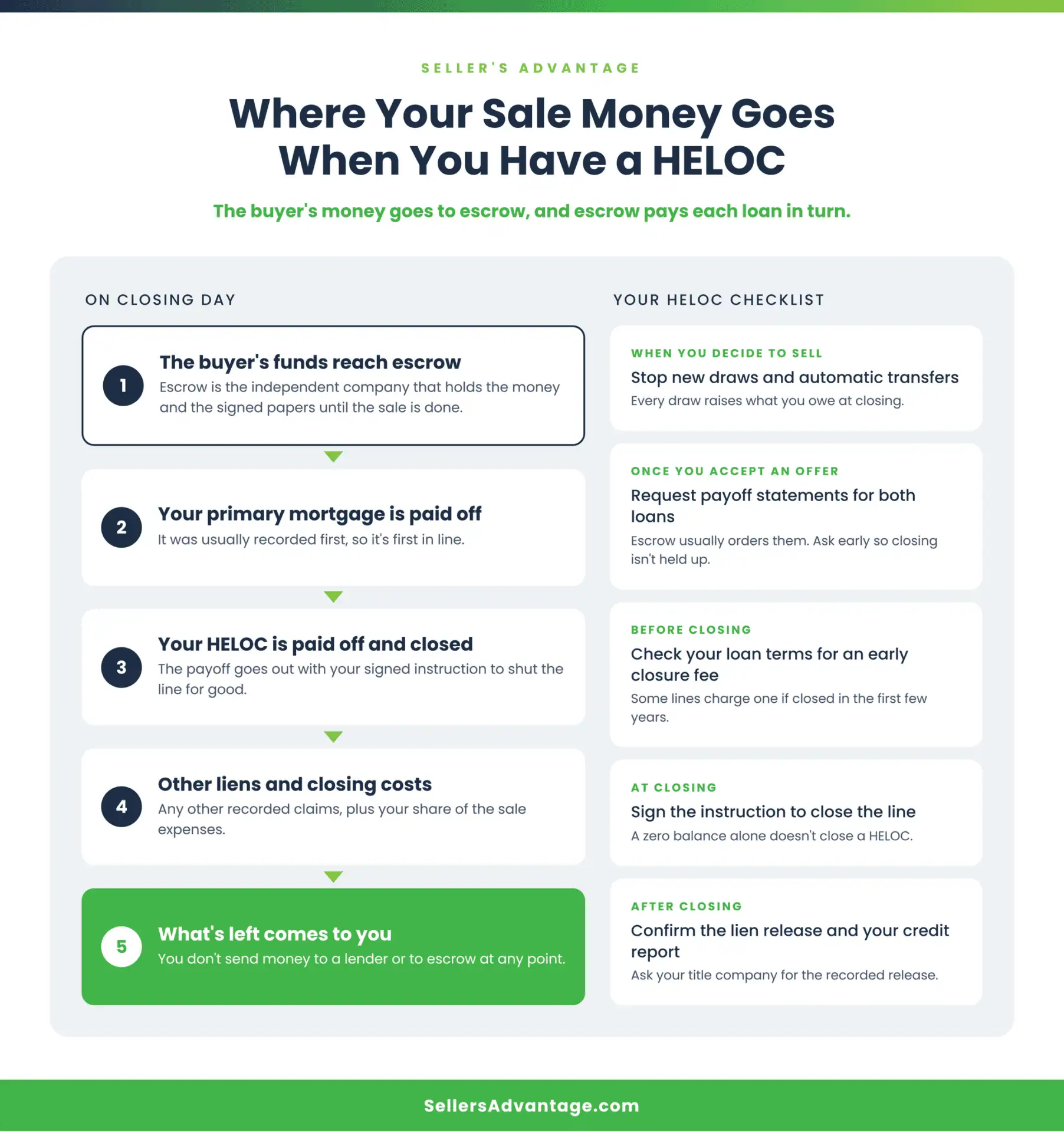
Many sellers are surprised to learn that paying a HELOC down to zero doesn’t end it. The line stays open. As long as you still have HELOC access, you, or anyone holding your HELOC checks or card, could draw on it again. That’s why the lien stays on record until the line is actually closed.
California has a set process for this. It runs through escrow, the independent company that holds the purchase money and the signed papers until the sale is complete. In some other states, a closing attorney handles this part. In California, an escrow officer, sometimes called the closing agent, usually does.
Under California Civil Code section 2943.1, escrow prepares a written instruction for you to sign. It tells your HELOC lender to suspend the line and close it. The form states that the line will be suspended for at least 30 days and that you can’t use the cards or checks tied to it. Once the lender has that signed instruction and the full payoff amount, the law requires it to close the line and release its lien.
It also helps to stop any automatic transfers that draw from the line, and to shred leftover HELOC checks once you’ve signed.
Before escrow can send any of this, it needs an exact number from each lender.
Getting Your Payoff Numbers
A payoff demand statement is the lender’s written figure for what it takes to clear your loan in full. It includes the principal, meaning the amount you borrowed and still owe, plus accrued interest and any fees. Accrued interest is interest that has built up since your last payment. You’ll also hear this called a payoff statement or payoff quote.
In most sales, escrow requests it for you. Under Civil Code section 2943, a lender generally has to deliver it within 21 days of receiving a written request. Ask for payoff statements on both loans as soon as you have an accepted offer, so a slow lender doesn’t hold up your closing date.
The statement shows what you owe on a set date, plus a daily interest figure escrow uses to find the closing-day amount. If you draw on the HELOC after the statement is issued, the outstanding balance goes up, and escrow will need an updated one.
Worth knowing: some HELOCs charge an early closure fee. The CFPB describes a cancellation fee that usually applies if you end the line within the first two or three years. Your HELOC agreement lists every fee the lender can charge, from application fees to annual fees. Check whether yours has an early closure fee and whether it’s a flat fee, so it isn’t a surprise on your closing statement.
A home equity loan can work differently. Some loans carry prepayment penalties, which are charges for early repayment of the balance. Your loan terms will say whether yours does.
With both numbers in hand, escrow can pay everyone on closing day.
What Escrow Does on Closing Day
Closing day is when most of the worry about two loans turns out to be unnecessary. By the time you reach the closing table, escrow already has the numbers it needs.
The buyer’s funds arrive at escrow by wire. From those home sale proceeds, escrow sends your primary mortgage lender its full payoff. It then sends the HELOC lender its payoff along with your signed instruction to close the line. If there are multiple liens, each one gets paid from the same funds. So does your share of all the expenses of the sale. The remaining funds after that are sent to you.
At no point do you move money to a lender or to escrow yourself. Scammers sometimes pose as escrow or title staff and email new wiring instructions near closing. If anyone asks you to send funds, call your escrow officer at a number you already know before you do anything.
Keep your final closing statement. It lists each payoff, and you’ll want it for the last step.
After Closing, Confirm the Lien Is Gone
It’s easy to feel finished once the sale closes. One more check makes sure the HELOC is closed for good.
When a loan secured by a deed of trust is paid off, the lender has to clear the record through a reconveyance. That’s a recorded document saying the loan is satisfied and the lien is released. Under Civil Code section 2941, the lender has 30 days after payoff to send the paperwork to the trustee. The trustee is the company named in the deed of trust to hold the lien on the lender’s behalf. The trustee then has 21 days to record the reconveyance with the county.
If neither one acts within 75 days of payoff, a title insurance company may record a release in its place. So around two months after closing, ask your title company for a copy of each reconveyance, or check your county recorder’s records.
A month or two after closing, it’s also worth pulling your credit report. Both loans should show as paid, and the HELOC should show as closed. If either one still shows an outstanding HELOC balance or an open line, call the lender with your closing statement in hand.
Everything above assumes the home sale covers both loans. Sometimes it doesn’t, and that calls for a different plan.
When the Sale Won’t Cover Both Loans
Finding out you owe money beyond what the house will bring can feel like a trap. It isn’t one, and plenty of homeowners who borrowed in good faith end up here after a price dip or a hard stretch.
Owing more than the home is worth is called negative equity. To find out how much equity you have, compare a realistic sale price with your mortgage and HELOC combined, then subtract the costs of selling. A real estate agent can prepare a comparative market analysis, a written estimate of value based on recent nearby sales. A formal appraisal is another option.
Your primary mortgage was usually recorded first, so it gets paid first. The second loan is paid only from what’s left, and its lender has to agree before a sale that leaves it short can close. If you don’t have enough equity to cover both loans, you have a few paths.
You can bring money to closing to cover the gap. Some sellers borrow money to do that, such as a personal loan, which is an unsecured loan not tied to the house. That adds a new debt with its own interest rates. It’s a personal finance decision worth talking over with a financial professional. You can also wait, pay the balances down, and sell later. Or you can ask the second lender to accept less than you owe. That’s called a short sale, and it needs the lender’s written approval.
A short sale carries a tax question to settle first. Forgiven mortgage debt may be counted as taxable income. The federal break for a main home covers only debt forgiven before January 1, 2026. California has had no matching break since 2014, as the Franchise Tax Board explains. Two other exclusions may still apply. One covers debt canceled in bankruptcy. The other covers insolvency, when what you owed was more than everything you owned. Have a certified public accountant (CPA) review your case before you sign any short sale approval, and talk with a real estate attorney about the approval terms.
Our guide to what a short sale in California actually costs covers lender approval and the tax rules in more depth. If you’ve already moved out of state, our resource on selling California real estate after you move away can also help you plan. A housing counselor approved by the U.S. Department of Housing and Urban Development (HUD) can also walk you through options at no cost.
If you have sufficient equity to cover both loans, the next choice is how to sell, especially if you’re considering selling your home as-is and the challenges that come with it.
Listing or Selling As-Is With a Second Loan
Both loans get paid through escrow the same way, however you sell. What changes is how long the loans stay open, what the sale process asks of you, and your potential proceeds.
A traditional Southern California home listing with a real estate agent typically stays on the market for about 90 to 120 days, followed by an additional 30 to 60 days in escrow.It tends to bring the highest price when the home shows well and the current market is strong. The costs come from commission, repairs a buyer’s inspection turns up, and months of interest payments on two loans while you wait. Escrow timelines also create some risk that a buyer’s financing falls through; our article on when a home sale falls out of escrow explains what that can mean. If you’re already listed and unhappy with the results, our guide to selling your California house when it’s already on the market walks through your options. Most HELOC rates are variable, meaning they can rise or fall, so that cost can change.
Selling as-is means selling the home exactly as it stands, without fixing anything first. A cash offer on an as-is home comes in below what a fully repaired listing might bring, since the buyer absorbs the repair bills and the unknowns. Many owners focus on the benefits of selling to cash investors when they want to avoid repairs and a drawn-out listing, especially in markets like Los Angeles where cash for houses programs and fast cash home buyers in Los Angeles are common. The number to compare is your net proceeds, the money you walk away with after every payoff and cost. Once commission, repairs, and carrying costs come out of the listing side, the gap is often smaller than it looks.
If you have plenty of equity and time, listing may put more in your pocket. We wrote about when selling for cash is the wrong move for that reason. For a broader look at the trade-offs, see our guide to selling a house as-is in California and to selling your house without listing it on the MLS.
Sellers with a second loan tend to ask the same handful of questions, and many of them also want broader tips from our sell my house fast blog articles for California home sellers.
Questions Sellers Ask About Second Loans
Do I need to pay off my HELOC before I list? No. Your mortgage and HELOC balances get paid from the sale money at closing.
Can I still draw on my HELOC while the house is on the market? Until you sign the instruction to suspend the line, the lender may allow it. Every draw raises your payoff and lowers what you take home. Most sellers stop drawing once they decide to sell.
My HELOC balance is already zero. Does it matter? Yes. The lien stays on record until the line is closed and the lender releases it. Escrow still needs a payoff statement showing zero, plus your signed instruction.
Will closing my HELOC affect my credit? Closing any of your credit accounts can change your credit profile, and how much varies from person to person. Your lender or a credit counselor can tell you what to expect for your financial situation.
Can I use a HELOC on my next purchase? Not the one on the house you’re selling, since it closes when the sale closes. If you want a line of credit on a new property, you’d generally apply for a new one after you buy.
What if I have other debts tied to the house, like a solar loan or a tax lien? Each recorded claim gets its own payoff and release through the same escrow. Our guides on selling with a solar lease or loan and selling with a tax lien explain how those work.
If you’re still weighing your options, we’re glad to talk them through.
When You’re Ready to Talk Numbers
A second loan is one more line on the closing statement, and it shouldn’t stop your plans. Knowing your payoff numbers early helps you spot potential complications before they slow down the closing process.
If you’d like to see what a direct sale would look like, a member of our team will come see the house first. A no-obligation cash offer may reach you within 24 hours of that visit. We don’t charge a commission. Our purchase also carries none of the contingencies, or conditions that let a buyer back out, that come with a traditional mortgage loan, and you can review our step-by-step cash home buying process ahead of time.
Closing can happen as early as 7 to 14 days after you accept. If you need more time to plan your move, we’ll set a later date that works for you, and nobody will hurry you out of your home. Our team stays with you through each step until the last paper is signed. We pay for the title insurance plus the escrow, recording, transfer, and government fees. Your proceeds cover the mortgage and HELOC payoffs, any recorded liens, and property taxes still owed, while our sell my house fast, we buy homes for cash as-is service is designed to keep the process simple.
And if listing would leave you with more after both loans are paid, we’ll tell you that too.
Talk with our team about your home and your loans →
Sell Your House Fast For Cash
We Buy Houses in Southern California As-Is
Close on your timeline and avoid the hassle of traditional fees.
Get My Free,
No-Obligation Quote
Call us today at 800-208-3243 and get an offer in as little as 24 hours. It’s quick and easy!
"*" indicates required fields
Southern California’s Most Trusted Home Buyers

