
Updated July, 2026
If you live in Los Angeles, you already know a cash offer on your home is not hard to find. Put your address into three websites tonight and you’ll have three people ready to talk by tomorrow morning. That’s not the hard part. The hard part is working out which of those buyers is worth talking to.
That’s what this guide is for. We’ll go through who’s actually buying in Los Angeles, what to look for in a company before you let anyone walk your property, and the local rules that catch sellers off guard. Then you can decide for yourself whether this is the right move.
The 5 Kinds of Cash Buyers You’ll Meet in LA
Companies offering cash for homes in Los Angeles don’t all operate the same way. The differences change what you can expect, from the offer itself to the timeline.
1. Licensed local brokerages that buy directly. These companies hold a California real estate license and purchase with their own funds. Because they’re licensed, they answer to the state Department of Real Estate and their record is public. Seller’s Advantage is in this group. Expect a person who lives in Southern California to walk your property and discuss the number with you directly.
2. National instant-offer platforms. These are technology companies that generate an offer from property data before anyone sees the house in person. Expect a fast preliminary number, a service fee deducted at closing, and an inspection afterward that can adjust the offer. Read the fee schedule closely, because the headline number and the closing number are often different.
3. Franchise buying operations. A national brand licenses its name to independently owned local offices. Expect consistent marketing and experience that varies quite a bit from one office to the next. Ask how long the local owner has been buying in LA, not how long the brand has existed.
4. Assignment operators. These companies put your home under contract and then assign that contract to an investor who wants to make updates or renovations. They aren’t planning to own the house themselves. Expect that the person you met may not be the person who closes, and that the deal depends on them finding someone who wants it. Ask directly whether they intend to purchase the property.
5. Individual investors and flippers. One person or a small partnership buying with their own money. Expect the most flexibility and the most variation. Some are excellent and have been doing this in your neighborhood for twenty years. Others are funding the purchase with a loan they haven’t secured yet, which quietly puts you back on a financing timeline.
None of these types of buyers are necessarily good or bad. It comes down to the specific company or person. For instance, a skilled individual investor can serve you better than a large company, and a platform offer can be exactly right for a house in good condition. What matters is knowing which one you’re talking to, because that tells you which questions to ask.
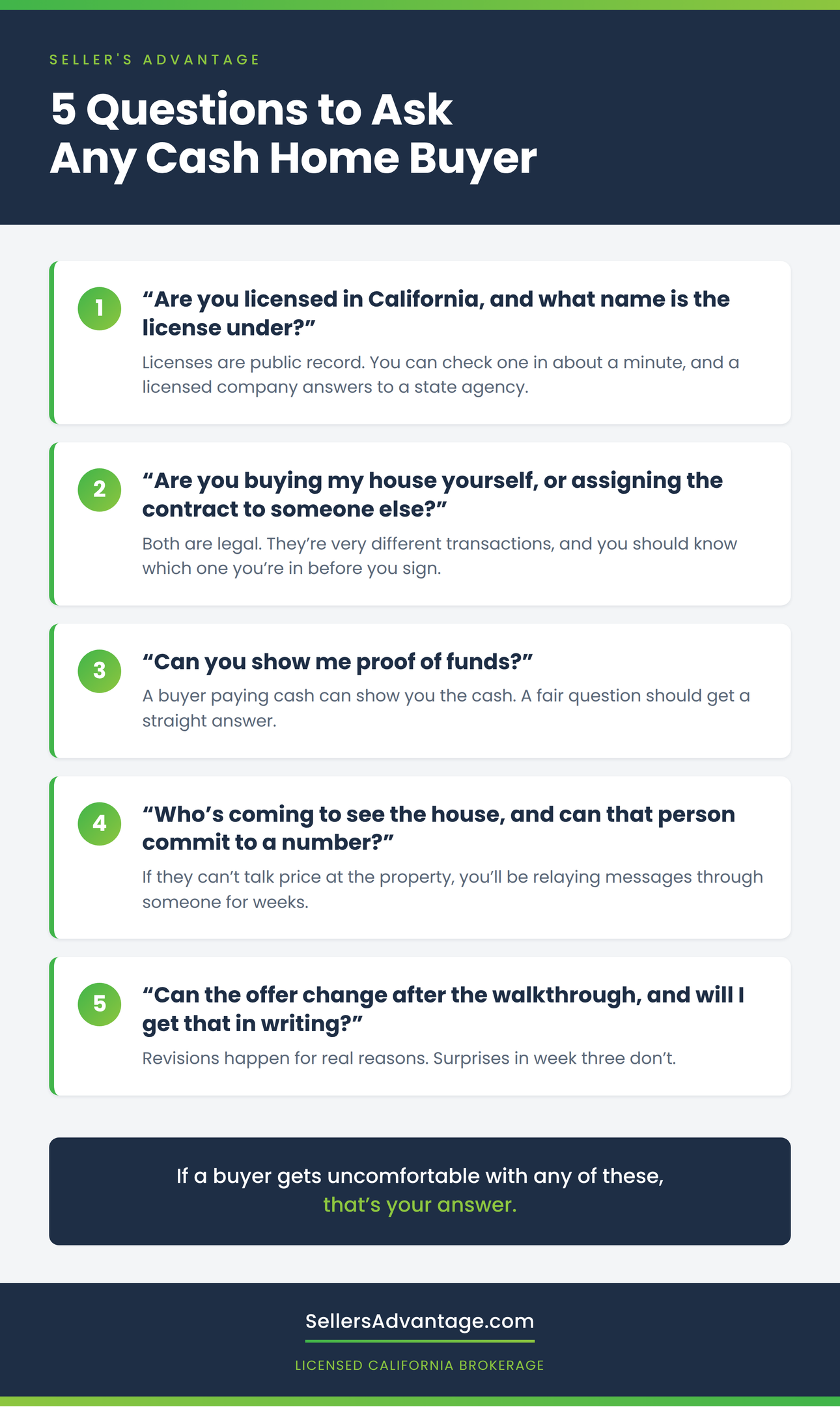
5 Questions to Ask Every Cash Buyer
Nobody wants to be taken advantage of, especially on the largest asset they’ll ever sell. Here are five questions to ask before you work with anyone.
“Are you licensed in California, and what name is the license under?” California keeps a free public record of every licensed real estate broker and salesperson in the state, searchable by company name in about a minute through the state’s license verification service. A license isn’t a promise of a good experience. It does mean a state agency can hear a complaint and act on it.
“Are you buying my house yourself, or assigning the contract to someone else?” Both are legal. They’re just different transactions, and you deserve to know which one you’re in before you sign.
“Can you show me proof of funds?” A buyer paying cash can show you they have the cash. A reasonable request should get a straightforward answer.
“Who’s coming to see the house, and can that person commit to a number?” If the person walking your property can’t talk about numbers, you’re going to be relaying messages through someone for the next two weeks.
“Can the offer change after the walkthrough, and will I get that in writing?” Some buyers give you a preliminary figure and revise it later. That isn’t automatically wrong, but you want it explained up front and in writing, not discovered in week three.
If a buyer becomes uncomfortable with any of these five questions, that’s your answer. For a closer look at the warning signs, we’ve written separately about what separates real cash buyers from scammers.
The LA Rules That Catch Sellers Off Guard
Selling in LA comes with a few local requirements you won’t find in the rest of California. Most homeowners run into them for the first time in escrow, which is a stressful place to learn about them.
The report you have to order before you can close
If your house sits inside Los Angeles city limits, you have to order a Report of Residential Property Records and hand it to the buyer before you sign a sale agreement or close escrow. Most sellers just call it the 9A. It runs $70.85 per parcel and covers things like smoke detectors, water conservation fixtures, and seismic gas shut-off valves. Nobody can waive it. The requirement is spelled out on the LADBS Residential Property Report page.
Selling as-is doesn’t get you out of it. If a buyer tells you otherwise, they either don’t buy inside city limits very often or they haven’t checked lately.
Who pays the transfer taxes, and what they add up to
Los Angeles County charges a transfer tax of $1.10 per $1,000 of the sale price. If your house is inside the City of LA, the city tacks on another $4.50 per $1,000. On a $900,000 sale inside city limits, that’s about $5,040 before anything else gets counted.
There’s also Measure ULA, an extra city transfer tax on higher-priced sales. For deals closing after June 30, 2026, it kicks in at 4% on sales of $5.4 million and up, and 5.5% at $10.9 million and up. Worth knowing: it’s calculated on the whole sale price, not on your profit. Most LA homeowners never get near those numbers, but the thresholds shift each year, and the Los Angeles Office of Finance posts the current ones.
On a Seller’s Advantage cash purchase, we cover the government fees, transfer fees, recording fees, escrow fees, and title insurance. You’ll only be responsible for your existing mortgage, any liens, and any unpaid property taxes.
As-is doesn’t mean you skip the disclosures
Selling as-is means you’re not agreeing to fix anything. It doesn’t mean you get to stay quiet about what you already know. California requires a Transfer Disclosure Statement on most home sales, and the legislature wrote it into the law that this can’t be waived in an as-is sale. A few situations are exempt, including some probate sales, so ask your escrow officer or attorney about yours.
This protects you more than it protects the buyer. Writing down what you know about the roof or the plumbing is what stops an argument from showing up six months after closing.
What You Actually Walk Away With
A cash offer will come in under what your house would sell for fully repaired on the open market. That’s true of every cash buyer in California. They’re taking on the repairs, the months of holding costs, and the risk that the work runs over budget, and the offer reflects all of it.
But the offer isn’t the number to focus on. What matters is what actually hits your account when everything’s done.
A traditional sale has subtractions of its own. There’s the agent’s commission. There’s whatever the buyer’s inspector wants fixed. There’s the transfer tax. And there’s every month of mortgage, insurance, and utilities you keep paying while the house sits on the market. For some homeowners, especially those trying to sell quickly in LA County, selling your home online or directly to a reputable cash buyer can narrow that gap even further. Add it all up, and the gap between the two options is usually a lot smaller than it looks at first.
That doesn’t mean cash is the right answer. For plenty of LA homeowners, it isn’t.
When Listing With an Agent Beats Selling for Cash
Sometimes the traditional route is just the better deal, and it’s worth being honest about when. Listing with a local real estate agent usually wins if:
- The house is in decent shape and shows well
- You’ve got three to six months and nothing pushing you to move sooner
- Showings and an inspection period won’t turn your life upside down
- You’re in a neighborhood where homes still pull competing offers
If that’s you, list it. A well-presented house in the right part of LA can still bring multiple offers, and no cash buyer is going to touch that number. Better to hear that now than figure it out after you’ve signed something.
What Working With Seller’s Advantage Looks Like
If a direct sale is the better fit, here’s the whole thing start to finish.
- The first call. You reach out, and we talk through your situation and your timeline. No pressure, no obligation.
- The walkthrough. Someone from our local team comes out to see the property, usually within a day or two. Don’t clean, don’t fix anything, don’t haul anything to the curb.
- The offer. You may receive a cash offer within 24 hours of us seeing the home, based on its condition, location, and what the LA market is doing.
- You pick the closing date. Closing can happen as early as 7 to 14 days, or we can extend the timeline to fit your needs. We won’t rush you out of your home.
- A cash advance if you need one. Some sellers need funds sooner, and when that’s the case, up to $20,000 may be available before closing. It comes out of proceeds you already own, so there’s no loan and nothing added to what you owe.
- Escrow and closing. The mechanics are simple: escrow holds everything until the sale is final. Our funds go to the escrow company, escrow settles your mortgage and any liens, and you receive what’s left. At no point do you personally move money.
We’ll walk you through each step and explain the paperwork clearly. For more on how we buy across the county, see our Los Angeles home buying page.
Questions LA Homeowners Ask Us
How do I get cash for my house in Los Angeles? Contact a buyer, let them see the property, and review what they offer. With us, that means a conversation, a walkthrough, and a no-obligation offer you’re free to turn down. Talk to more than one buyer if you have the time.
Do cash buyers pay the closing costs on an LA sale? It varies by company, so ask before you assume. On a Seller’s Advantage cash purchase we cover the government fees, transfer fees, recording fees, escrow fees, and title insurance. You remain responsible for your existing mortgage, any liens, and any unpaid property taxes.
Do I still need the 9A report if I’m selling as-is? Yes, if the property is inside the City of Los Angeles. The requirement attaches to the sale, not to the condition of the house, and it can’t be waived.
Can I sell with tenants still living in the property? Often yes, though California and local LA tenant protections shape what you can and can’t do and when. Get specific advice before you give anyone notice. We cover this in more depth in our guide to selling a tenanted property.
How fast does a cash for homes California sale actually close? With us, as early as 7 to 14 days once you accept, or longer if you need more time. Title issues, liens, or probate can extend that, and a buyer who promises a fixed date before checking title is guessing.
Will I owe taxes on the sale? That depends on your basis, how long you owned the home, and whether it was your primary residence. We aren’t tax advisors, so talk with a CPA about your specific numbers before you commit to anything.
Talk It Through With Someone Local
You don’t have to decide anything today. Take those five questions from earlier and ask them to every company you talk to, including us. Anyone worth working with will happily answer them.
If you’d like a real number to set next to what a listing might bring, we’ll come out and take a look at the house. No obligation, no pressure to move forward, and no hard feelings if you go another direction. And if listing with an agent makes more sense for your situation, we’ll tell you that too.
Sell Your House Fast For Cash
We Buy Houses in Southern California As-Is
Close on your timeline and avoid the hassle of traditional fees.
Get My Free,
No-Obligation Quote
Call us today at 800-208-3243 and get an offer in as little as 24 hours. It’s quick and easy!
"*" indicates required fields
Southern California’s Most Trusted Home Buyers

